and unhappy Albert, the hard-working Saxon Elector.
-The relaxed, navy-cut beard of the one,
hysterical, bristling moustaches of the other…….
The Expressionists were Rupert Brooke’s generation.
Their hold on life was weaker than a baby’s.
Their deaths, at whatever age, were infant mortality-
a bad joke in this century. Suddenly become sleepy,
they dropped like flies, whimsical, sizzling,
ecstatic, from a hot light-bulb. Even before the War,
George Heym and a friend died from a skating accident.
From 1914, they died in battle and of disease-
or suicide like Trakl. Drugs Alcohol Little Sister.
One was a student at Oxford and died, weeks later,
on the other side……..Later they ran from the Nazis.
Benjamin was turned back at the Spanish border-
his history of the streets of Paris unfinished-
deflected into an autistic suicide. In 1938,
Ödön von Horváth, author of naturalistic comidies,
was struck by a falling tree. In Paris.
At the time
my anthology was compiled, there were still a few left:
unexplained survivors,
psychoanalysts in the New World.
From the collection of Michael Hoffmann’s selected poems at http://www.amazon.co.uk/Selected-Poems-Michael-Hofmann/dp/0374532230/ref=sr_1_fkmr2_2?ie=UTF8&qid=1403993437&sr=8-2-fkmr2&keywords=michael+hoffman+Selected++poems- This web-address also contains two useful reviews.
There is an interesting discussion of the concept of Sehnsucht at http://en.wikipedia.org/wiki/Sehnsucht#In_psychology where it rather neatly states from Scheibe, S.; Freund, A. M., & Baltes, P. B. (2007). “Toward a developmental psychology of Sehnsucht (life longings): The optimal (utopian) life”.Developmental Psychology (43): 778–795;(Psychologists have worked to capture the essence of Sehnsucht by identifying its six core characteristics: “(a) utopian conceptions of ideal development; (b) sense of incompleteness and imperfection of life; (c) conjoint time focus on the past, present, and future; (d) ambivalent (bittersweet) emotions; (e) reflection and evaluation of one’s life; and (f) symbolic richness.”
Janet Lynch Woman
It is not quite nostalgia but clearly a term that can be associated with Romanticism. The above link makes clear that, ” Sehnsucht is a compound word, originating from an ardent longing or yearning (das Sehnen) and addiction (die Sucht)”. Hence, Schiller writes:-
O zarte Sehnsucht, süßes Hoffen,
Der ersten Liebe goldne Zeit!
Das Auge sieht den Himmel offen,
Es schwelgt das Herz in Seligkeit.
O dass sie ewig grünen bliebe,
Die schöne Zeit der jungen Liebe.
( O tender yearning, sweet hope, the first love golden time! The eye sees the heavens open, it revels in the heart of bliss. O that they would remain ever green, The beautiful time of young love.)
JanetLynch Knowing
Indeed, zarte is another lovely word indicating great tenderness. Collins large dictionary gives this example- der dritte Satz hat etwas Sehnsüchtiges – the third movement has a strangely yearning quality.
Here is Hartmann’s Poem-
Und kommst du nicht am Tage
Und kommst du nicht am Tage,
So komm im Traum zu mir;
Gewiß, gewiß ich sage
Dir tausend Dank dafür.
Komm immer so wie heute,
Da ich entschlummert kaum,
Wie holdes Brautgeläute
Erklang mein ganzer Traum.
Wohl sind noch meine Lider,
Wenn ich erwache, feucht –
Doch komme immer wieder,
Vor Glück weint’ ich vielleicht.
Ich fleh’ es, wie mit Kosen
Der Nachtigall Gebet
Vom jungen Frühling Rosen
In kalter Nacht erfleht.
O komm mit aller Plage,
Die du mir schon gebracht,
Und kommst du nicht am Tage,
So komm im Traum der Nacht.
Hartmann (1821 – 1872), was an Austrian writer and a radical politician, member of the Frankfurt National Assembly, wrote among other things, “Chalice and Sword”-»Kelch und Schwert« More information may be found at http://de.wikisource.org/wiki/BLK%C3%96:Hartmann,_Moriz
JanetLynch In the Clear
Don’t come in daytime
Don’t come in daytime
but come to me in my dreams.
Confidently, certainly, gladly
I thank you again one thousand times
Always come like you did today,
since I can scarcely slumber.
Lovely wedding bell chimes echo
through all my dreams
Even my eyelids are refreshed
when I awake with tears.
Always come back again
blissfully crying, “I might”.
I beg you with a tender caress
like the nightingale’s plaintive song
amidst young spring roses
yearning into the chill of the night.
Come again with all the trouble you have already brought
But don’t come by daytime
But come in dreams by night!
As usual there is much to learn from Goethe, particularly at -http://en.wikipedia.org/wiki/Nur_wer_die_Sehnsucht_kennt and perhaps another time is needed to tease out the meanings of Leidenschaft but here is as good a start as any :-http://synonyme.woxikon.de/synonyme/leidenschaft.php
JanetLynch Forgetting
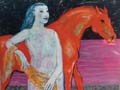
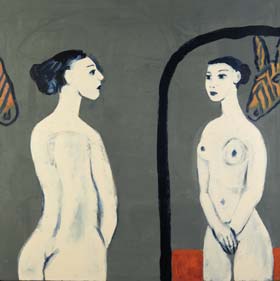
There is a great exhibition of Janet Lynch’s beautiful paintings from Cornwall Contemporary at the moment and they go rather well I hope with the poem. Please see http://www.cornwallcontemporary.com/JanetLynch_JaneMuir53.html
Flügelt ein kleiner blauer
Falter vom Wind geweht,
Ein perlmutterner Schauer,
Glitzert,flimmert,vergeht.
So mit Augenblicksblinken,
So im Vorüberwehn
Sah ich das Glück mir winken,
Glitzern,flimmern,vergehn.
Während ich mich über meine Stickerei am Fenster bückte,
Stach mich meine Nadel in den Daumen. Weiße Rose,
Die ich stickte,
Wurde rote Rose.
In der kriegerischen Weite bei des Vaterlandes Söhnen
Weilt mein Freund, vergießt vielleicht sein Blut.
Rossehufe hör ich dröhnen.
Ists sein Pferd? Es ist mein Herz, das wie ein Fohlen tut.
Tränen fallen mir aus meinen Blicken
Übern Rahmen in die Stickerein.
Und ich will die Tränen in die Seide sticken,
Und sie sollen weiße Perlen sein.
Bending down over my embroidery at the window,
I stick the needle into my thumb.
The white rose that I was stitching,
became red.
Through the vast martial expanses, the sons of our native land,
Steady my friend, perhaps they are shedding their blood.
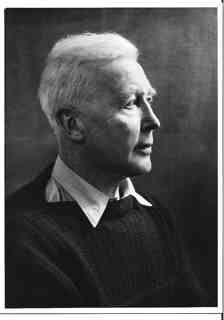
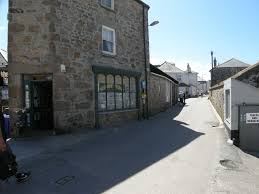
Frank Ernest Halliday was a very enthusiastic walker. Tall with a mane of beautiful white hair and reserved, his elegant stride cut a figure, like a distinguished prophet or poet. He was when, first I became aware of his reputation as a historian and a Shakespearian scholar, hurrying down Back Road West in the general direction of Clodgy where he frequently seemed inclined to walk, frequently at this formidable pace. At about this time, he had already retired from school mastering at Cheltenham College where he had become a friend of Cecil Day-Lewis years before. That was in the early Thirties and the time to which I am referring was somewhere around 1960.
F.E.Halliday
In 1953, Halliday wrote in History Today of the famous Cornish Historian, Richard Carew, a Member of Parliament and a friend of Philip Sydney,” The importance of Richard Carew has never been appreciated. Few, indeed, are even aware of the writer who, while Shakespeare was writing for the London stage, was quietly at work in his Cornish country house. This neglect is the result of his own modesty, the remoteness of his dwelling, and the multitude of his great contemporaries in and about the capital, and not of any lack of merit…..” Much of what Halliday wrote here about Carew is now equally true about himself and the extensive range of his own work. It is time to remember Halliday’s work, much of it written in his house next to the sea, downalong in St Ives. (Those interested in Carew will find a brief entry at http://en.wikipedia.org/wiki/Richard_Carew_(antiquary))
Back Road West, St Ives
When Halliday’s Shakespeare appeared in an American edition in 1961, it was reviewed in the Renaissance News a little later;-
“Mr F.E.Halliday’s life of Shakespeare is the product of a widely read, fully informed, and prolific mind. After twenty years as head of the English Department at Cheltenham College he retired in 1948 to devote himself solely to writing. He is one of the few scholars today who have taken all Shakespearean knowledge as their province. For a period of over fifteen years he has been turning out studies which give an ever broadening view of the great dramatist. In 1946 he published Shakespeare in his Age. Then came Shakespeare and his Critics which although completed in 1947, first appeared in 1949.”
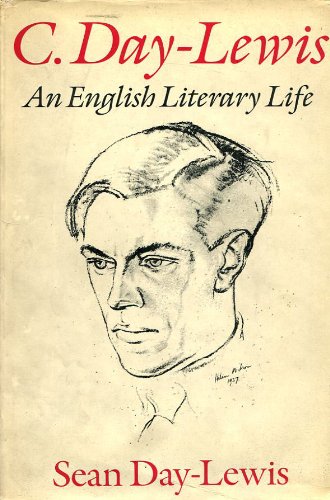
Halliday was educated in North Yorkshire at Giggleswick School where he learnt to cherish Latin poetry, including Horace and his reflections on the seasons, mutability and loss grew up in its unique atmosphere. He was growing up in the dark and difficult days of World War 1 which deeply affected both staff and boys. There is a useful short biography of him included in Cornwall’s People – A Biographical Dictionary by Carolyn Martinand Paul White (Tamar Books). He then went on to King’s College, Cambridge and later entered teaching himself. It was at Cheltenham College that he met and became a supportive friend to Cecil Day-Lewis, the famous thirties poet. Indeed, Halliday, who was an English master and became Head of Department, painted Day-Lewis’s portrait which is in the National Portrait Gallery and may be seen at http://www.npg.org.uk/collections/search/portraitLarge/mw07276/Cecil-Day-Lewis?LinkID=mp01220&search=sas&sText=Day-Lewis&role=sit&rNo=0
This portrait captures the refined appearance of the poet in a contemplative mood in profile but whether marking an essay or composing a splendid poem is not clear. Day-Lewis’s meeting and friendship in 1931 with Frank Halliday is recorded in some detail in Sean Day-Lewis’s biography of his father C. Day-Lewis, An English Literary Life. It appears that the dress code at Cheltenham was somewhat severe. Also Day-Lewis’s poetry was considered risqué when discovered by the self-appointed proctors of moral rectitude among the other masters. He was accused in a letter from the Headmaster of Bohemian tendencies!
“An Assistant Master at the school had seen him wearing a green shirt, while whitewashing the
walls of his flat, and another observer had reported the poet attending a concert with a stock about his neck under his dinner jacket: this was intolerable conduct, the staff must be properly dressed at all times.
Before replying he took the advice of a college master who, unlike the colleagues who had reported all departures from convention, was a friend. Frank Halliday was a sensitive Yorkshireman who loved literature and eventually became a writer himself. His autobiography tells how he first heard of Cecil as ‘a young married man who liked Beethoven and César Frank’ and was ‘said to write poetry’. He met the newcomers during their second term and registered Mary ‘with ballet dancer’s hair and figure and a dairy maid’s complexion’ and Cecil ‘reserved and almost severe with the trace of an Irish brogue’. Halliday was also a shy man and his mask was an offhand manner, at first discouraging. The discouragement had been overcome and by this March, Cecil and Mary had become friends with Frank and his wife Nancie, and they spent a long time discussing the best response to the headmaster’s outburst.” (Sean Day-Lewis on his father- Halliday’s own biography is called Indifferent Honest, Duckworth 1960)
Halliday’s friendship with Day-Lewis was to last over forty years and much of it conducted by letters from St Ives where he seems to have lived first at Five Fields, Dynas Ia and later when they were completed in Barnaloft Flats, overlooking Porthmeor Beach. Day-Lewis was deeply interested in Marxism and wrote, somewhat ironically to Halliday about the class war and the colourful inhabitants of his local pub at Brinclose, near Axminster, of the News Chronicle, Liberalism and of course in 1938 of Chamberlin and the approach of the Second World War. Day-Lewis moved in an interesting circle of thirties poets and writers and it seems likely that Halliday too might have met such figures as Rex Warner and W.H.Auden. F.E.Halliday seems to have continued as an amateur artist and painted Brinclose in 1939. By 1942 Day-Lewis is working some sixty hours a week at the Ministry of Information and became a close associate of Charles Fenby, journalist and assistant editor of The Picture Post. Day-Lewis records an encounter at this time with another somewhat severe character, Arthur Koestler whom he mentions in his correspondence with Halliday. Day-Lewis’s letters have recently, in 2012, been donated to the Bodleian Library http://www.theguardian.com/books/2012/oct/30/cecil-day-lewis-letters-oxford.
The Wreck of The Firebrand
By the 1960s after the suppression of the Hungarian uprising, which had incidentally also prompted Halliday to sign a letter to the Times, Day-Lewis vigorously renounced his earlier communist views. By 1968, Day-Lewis, who also wrote detective novels as Nicholas Blake, became Poet Laureate. However, in 1971 Day-Lewis mentions to Halliday, a searing review he received from another Cornish poet in the TLS. He correctly identifies the critic as Geoffrey Grigson who having been born in Pelynt was a Cornishman, and held somewhat negative views on Cecil Day-Lewis’s poetry although unlike his earlier Headmaster, regarded him on the single occasion they met at the BBC, as elegantly dressed!
In addition to his Shakespearian Studies, Halliday was active with regard to social and political concerns. In 1963, he signs a letter to the Times along with John Betjeman, A.L.Rowse, Brian Wynter and more than thirty other prominent citizens against the Admiralty’s proposal to take some 355 acres for troop and helicopter training on the lovely Zennor moors. This was a major concern in Penwith at the time. This upset many local people and not least as the land had been placed under a special covenant by the National Trust. In 1975, just over 67% of voters supported the Labour government’s campaign to stay in the EEC, or Common Market and Halliday was writing to the Times again to advocate full political union; not just an economic agreement. Halliday was advocating a Yes vote because he strongly believed in the idealism needed to bring about an effective World government.
There was also a wryly amusing letter written at the end of December 1964(Shakespeare’s quatercentenary) with regard to a production by Lindsey Anderson of Julius Caesar. Anderson was a pupil of Halliday at Cheltenham, where the former also met the future novelist, Gavin Lambert. Halliday gently chides his former pupil for trying to ‘improve Shakespeare’, essentially by excising nine revealing lines of a speech by Brutus. These lines reveal much about the republican’s character. He compares this with how in the Restoration, much was made of Caesar’s ghost who was made to appear at Phillipi. Halliday proceeds to regret the trend towards displaying gratuitous violence in the History plays, whilst making it clear that he is not referring thus to Anderson and expressing his sorrow that Falstaff is being reduced to a sinister figure. He remarks that although he had tickets at Stratford for seven plays he could actually only stomach attending five and a half! The previous year, in another letter to the Times he had taken on the subject of the identity of W.H. of the Dark Lady Sonnets, an unknown William, he surmises, and disagrees somewhat daringly with the inimitable A.L.Rowse.
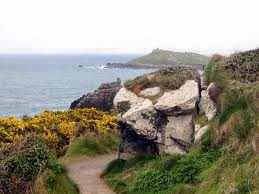
The walk past Man’Head to Clodgy, St Ives
Recently, while reading my own copy of A History of Cornwall, published by Gerald Duckworth in 1959, I became intrigued by a fine chapter on the Eighteenth Century; a generally neglected period but here there was a rich variety of detail. I was particularly interested in the earlier part of the Century, essentially before the mineral wealth of the Duchy had been much exploited. This was an unsettled period of rebellions and Halliday points out, “ Impoverished by the Civil War, the Cornish people took little interest in the events that followed the death of Charles II- the Monmouth Rebellion, the Revolution of 1688, the Jacobite Rebellion of 1715-…” In St Ives, which had had a Parliamentary army garrisoned there, the inhabitants might keenly have felt ravages of occupation. There are also records showing that Monmouth was blown off course there on his way to Weymouth and his future defeat at the Battle of Sedgemoor. The Treaty of Utrecht which interestingly, has recently escaped much notice upon its 300th Anniversary provided a temporary peace to the Wars of the Spanish Succession and its signature was celebrated in St Ives at the time. Travel then was most easily carried out by sea although as the experience of Sir Cloudesley Shovell wrecked on the Scillies suggests, navigation was a hazardous affair particularly in determining longitude. http://en.wikipedia.org/wiki/Scilly_naval_disaster_of_1707
Halliday remarks that this period around 1700 was characterized by a change in land ownership. Lawyers, merchants and businessmen started to invest in land that might be valuable more for the materials beneath the surface than as a source of food that gave it value to the gentry. This is a period where speculation starts to become important and clashes between the older aristocracy and the emerging entrepreneurs. This was particularly true in the western part of the Duchy where the known lodes existed. Halliday points to Celia Fiennes travel diary. He quotes her references to the shortage of timber for mine construction and the shortage of fuel. She writes, “They burn mostly turffs, which is an unpleasant smell; it makes one smell as if smoaked by bacon.” Fiennes, as Halliday points out, had to travel by horse because the roads were in such a poor condition. Copper was mined alongside tin but because of the shortage of fuel it was shipped to Bristol and South Wales for smelting. Little Cornish horses, she tells us were used to carry fish and the corn which was being cut.
The early C18, which Halliday covers in about thirty pages, sees the introduction of the first steam engine in about 1710. It was the very inefficient Newcomen engine, although state of the art at the time, and was used at the Godolphin mine at Wheal Vor. It used vast quantities of fuel. Even by 1740 there were just three steam pumps at work. It was not until the early Nineteenth Century that Cornish engineers greatly improved the efficiency of those engines that had be designed by Watt, Trevithick and others http://en.wikipedia.org/wiki/Cornish_engine. Thus in effect this would henceforth reduce the cost of coal which had to be imported from South Wales, a trade in the hands of merchants and businessmen. Incidentally, it was a German Chemist, a proponent of the celebrated but misguided Phlogiston theory, Johann Joachim Becker (1635-1682) from Speyer near Heidelburg, who visiting Cornwall in the 1680s made an important discovery. At Treloweth, St.Erth, that Becher was said to have built a furnace for the smelting of tin using pit coal as opposed to charcoal. http://de.wikipedia.org/wiki/Johann_Joachim_Becher
The celebrated Tory politician who rose to become Marlborough’s confrere and the First Lord of the Treasury, Sidney Godolphin, 1st Earl of Godolphin, KG, PC (15 June 1645 – 15 September 1712) might well be remembered for the work he did in passing the Act of Union with Scotland which created the united kingdom of Great Britain. He also established sound finances for Queen Anne and made possible the founding of the Bank of England. The Cornish might, however, have other reasons for remembering him as Halliday points out:-
…..”some of the old charcoal-using blowing houses were retained for smelting stream tin, which was of a finer quality than that from the mines. The use of coal probably saved Cornwall from being completely denuded of timber, the demand for which for shoring up the workings was enormous, and one of the last services that Godolphin did for his native county was to cheapen the price of coal by securing a drawback of the duty on that used for smelting. A few years before, in 1703, he had been responsible for the favourable terms of pre-emption granted to the Cornish tinners.” This unfortunately ended when Walpole came to power.
Frank Halliday was not only an author with broad interests, having written books on Chaucer, Dr Johnson, Wordsworth, Hardy and Browning besides Shakespeare; he was also a committed intellectual who was active as a School Governor, interested in social action and helped to set up with Bernard Leach and Barbara Hepworth in 1967, the St Ives Trust http://www.stivestrust.org/ which has been instrumental in developing conservation projects and working in alongside the St Ives Archive Centre. http://www.stivesarchive.co.uk/resource/
F.E.Halliday was an experienced lecturer and I can still recall a historical talk which he gave when I was a young lad in The Labour Party Rooms upstairs behind the back of the Union Hotel at the bottom of Ayr Lane. This is currently a rather chic restaurant but in the Sixties, a quite barely furnished room at the top of a steep winding wooden staircase. The subject concerned the early history of Cornwall and was concerned the Early Bronze Age and I particular recall much mention of the Beaker Folk (Glockenbecherkultur). Halliday’s tall figure loomed over slides showing the migrations of these people over Southern England at a time when Britain’s only significant export material was in fact Cornish tin. http://en.wikipedia.org/wiki/Beaker_culture. He mentions in a chapter on the Bronze Age in “A History of Cornwall” that, “Beakers are rare, but two have been found as far west as Land’s End, both of them in cists, and one, now in St Buryan church, accompanied by a flint knife.” It would be interesting to know if it is still located there.
Spread of the Beaker Culture
Speaking about Cornwall he says,” And I loved it for its character: for its strength, although an outcast among counties; for its appearance of having known and suffered so much, yet without any trace of disillusionment, but having rather an air of expectancy; for its human virtues of patience and endurance; for its mystery…”
Empieza el llanto
de la guitarra.
Se rompen las copas
de la madrugada.
Empieza el llanto
de la guitarra.
Es inútil callarla.
Es imposible
callarla.
Llora monótona
como llora el agua,
como llora el viento
sobre la nevada.
Es imposible
callarla.
Llora por cosas
lejanas.
Arena del Sur caliente
que pide camelias blancas.
Llora flecha sin blanco,
la tarde sin mañana,
y el primer pájaro muerto
sobre la rama.
¡Oh, guitarra!
Corazón malherido
por cinco espadas.
An introductory video may be found at http://www.youtube.com/watch?v=eCwqZjku16A
The weeping of the guitar
begins.
The goblets of dawn
are smashed.
The weeping of the guitar
begins.
Useless
to silence it.
Impossible
to silence it.
It weeps monotonously
as water weeps
as the wind weeps
over snowfields.
Impossible
to silence it.
It weeps for distant
things.
Hot southern sands
yearning for white camellias.
Weeps arrow without target
evening without morning
and the first dead bird
on the branch.
Oh, guitar!
Heart mortally wounded
by five swords.
Alte Plätze sonnig schweigen.
Tief in Blau und Gold versponnen
Traumhaft hasten sanfte Nonnen
Unter schwüler Buchen Schweigen.
Aus den braun erhellten Kirchen
Schaun des Todes reine Bilder,
Großer Fürsten schöne Schilder.
Kronen schimmern in den Kirchen.
Rösser tauchen aus dem Brunnen.
Blütenkrallen drohn aus Bäumen.
Knaben spielen wirr von Träumen
Abends leise dort am Brunnen.
Mädchen stehen an den Toren,
Schauen scheu ins farbige Leben.
Ihre feuchten Lippen beben
Und sie warten an den Toren.
Zitternd flattern Glockenklänge,
Marschtakt hallt und Wacherufen.
Fremde lauschen auf den Stufen.
Hoch im Blau sind Orgelklänge.
Helle Instrumente singen.
Durch der Garten Blätterrahmen
Schwirrt das Lachen schöner Damen.
Leise junge Mütter singen.
Heimlich haucht an blumigen Fenstern
Duft von Weihrauch, Teer und Flieder.
Silbern flimmern müde Lider
Durch die Blumen an den Fenstern.
Georg Trakl Aus der Sammlung Gedichte 1913
Here is my translation:-
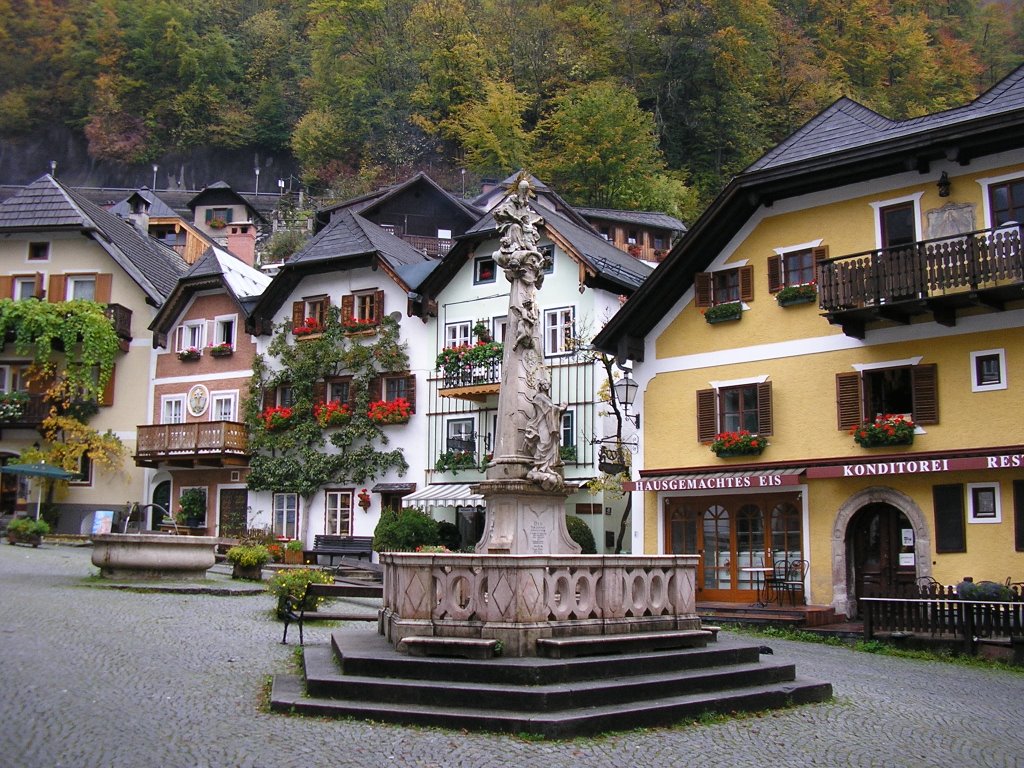
The Old Square
The ancient square sleeps in sunlight
making deep blue and golden threads
like a spiderweb.
Nuns come and go, gliding gently,
under the sultry silent beech trees.
From inside the illuminated church glimpses
show pure images of Death,
grand princes and magnificent shields.
Crowns gleam down above the aisles.
Horses heads appear from the ancient spring,
Sharp thorns threaten and bristle beneath the trees.
Young men confused with crazy dreams
in the evening gently approach the fountain.
Girls stand in doorways,
appearing shyly into the colourful square.
Their moist lips tremble
as they wait in their doorways.
Resounding, trembling bells
beat out the march with waking calls.
Strangers eavesdrop to their stirring calls.
High into the blue air the organ sounds.
Musical instruments sing high and clear
through the gardens and their leafed surrounds
The laughter of beautiful women sounds
and softly a young mother sings.
Breathe in the fragrance at the flowered sills,
Scents and incense, tar and lilac.
Silver glints through tired eyelids
through the flowers on the window ledges.
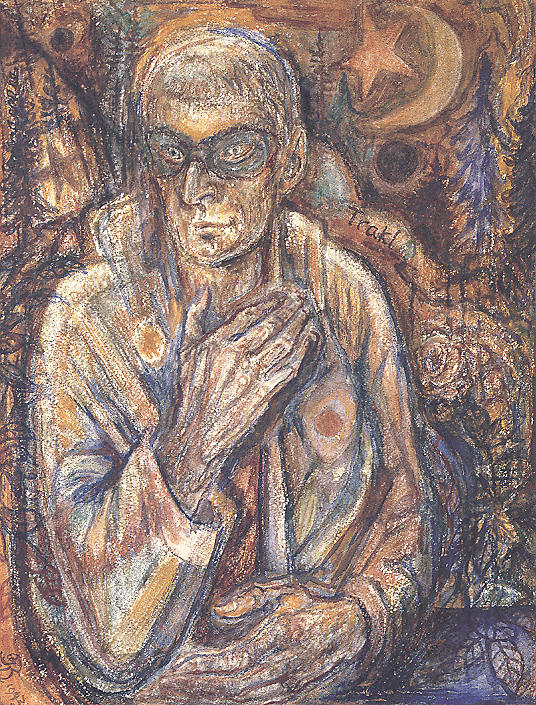
Trakl’s poetry is haunting, symbolist and expressionist. His story is to be found at http://www.kulturvereinigung.com/en/georg-trakl/brief-biography/ and many clips may be found at http://www.youtube.com/results?search_query=Georg%20Trakl&sm=3
Die linden Lüfte sind erwacht,
Sie säuseln und wehen Tag und Nacht,
Sie schaffen an allen Enden.
O frischer Duft, o neuer Klang!
Nun, armes Herze, sei nicht bang!
Nun muß sich alles, alles wenden.
Die Welt wird schöner mit jedem Tag,
Man weiß nicht, was noch werden mag,
Das Blühen will nicht enden.
Es blüht das fernste, tiefste Tal:
Nun, armes Herz, vergiß der Qual!
Nun muß sich alles, alles wenden.
Faith In Spring
The gentle winds are awakened,
They murmur and waft day and night,
They create in every corner.
Oh fresh scent, oh new sound!
Now, poor dear, fear not!
Now everything, everything must change.
The world becomes more beautiful with each day,
One does not know what may yet happen,
The blooming doesn’t want to end.
The farthest, deepest valley blooms:
Now, poor dear, forget the pain!
Now everything, everything must change.
Allbekant sind jene Blitze
hergebracht vom blauen Dunst.
Wettern sie durch Sommerhitze,
ist’s Natur und keine Kunst.
Aber wenn im Frost erzittert
jeglicher Naturbesitz,
welch ein Wunder, wie’s gewittert!
Und den Winter traf der Blitz.
• The Kraus Project by Jonathan Franzen is published by Harper Collins on 1 October. To pre-order it for £15.19 with free UK p&p call Guardian book service on 0330 333 6846 or go to guardianbookshop.co.uk.
Ich möcht liegen und schlafen
und schlafen die ewige Ruh
ich wollt’, die Engelein kämen
und drückten die Augen mir zu.
Ich wollt’ ich wollt’ es wär Winter
und Alles in ewigen Schnee,
und Winter, ewiger Winter,
er deckte auch mich und mein Weh.
O Winter, ewiger Winter!
Mir bangt vor der eisigen Ruh
Doch weiss ich, die Engelein kämen
Und drückten die Augen mir zu.
Altes Kaminstück – Old chimney piece – von: / from: Heinrich Heine. (1797 – 1856)
Draußen ziehen weiße Flocken / Outside all white flakes are drawn / durch die Nacht, der Sturm ist laut; / through the night, the storm is loud; / hier im Stübchen ist es trocken, / here in the little room it is dry, / warm und einsam, still vertraut. / warm and lonely quiet familiar.
Sinnend sitz ich auf dem Sessel, / Brooding I am sitting on the armchair, / an dem knisternden Kamin, / close at the crackling fireplace, / kochend summt der Wasserkessel / boiling hums the kettle / längst verklungene Melodien. / long fading melodies.
Und ein Kätzchen sitzt daneben, / And a kitten sitting next to it, / wärmt die Pfötchen an der Glut; / warms their paws on the embers; / und die Flammen schweben, weben, / and the flames are floating, weaving, / wundersam wird mir zu Mut. / wondrous feeling all in me.
Dämmernd kommt heraufgestiegen, / Dawning is ascending, / manche längst vergessene Zeit, / some long forgetting time, / wie mit bunten Maskenzügen / as with colorful masks and tails / und verblichener Herrlichkeit. / and departed glory.
 The Kaiser was the first Cousin of George V,








 Aus der Sammlung Gedichte 1913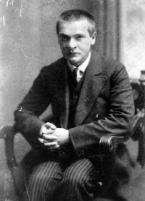



 penwithlit