Categories
Uncategorized

‘The Disappearance of Émile Zola’ by Michael Rosen

I heard Michael Rosen talk about this last year. Must get around to reading.

Jonathan's avatarIntermittencies of the Mind

I haven’t posted much in the last month what with being busy at work, the World Cup occupying much of my time and the warm summer weather not being favourable for sitting at a computer screen. So blogging has taken a bit of a back-seat, but I have been reading quite a bit. One of the books I read recently was Frederick Brown’s book on the belle epoque era in French history, For the Soul of France, which has the subtitle Culture Wars in the Age of Dreyfus. That book covers significant events such as the rise and fall of General Boulanger, the crash of the Union Générale, the Panama Scandal and of course the Dreyfus Affair as well as others. The Dreyfus Affair becomes more fascinating the more I read of it and Brown’s book was especially useful as it helped put the events into context. I…

View original post 859 more words

Categories
Art and Photographic History German Matters Literature

Artists and Illustrators published from London in1933

Perusing the London Illustrated News from early 1933, is to immerse oneself in a world which seems remote from our own yet the events shape our modern attitudes. The Empire appears secure with photographs of Imperial India, the Viceroy and his family surrounded by flunkies. Trouble is afoot in Moscow where staff from the British Embassy have been arrested and there are sketches of the process of interrogation where the accused stands and the commissar slouches at his desk. There are photographs of new pontoons in Venice, new aircraft -flying boats with generous accommodation and strange giro-copters whose instability proves as unsurprising as their appearance. Compared with the same publication twenty years before there are regular pages on the “kinema” and engravings are no longer to be seen. Platinum blondes are much in vogue as the photographs of beauty queens clearly portray and the permanent wave has arrived everywhere. The photographs of the rise of the Nazis and their integration with members of the German ruling class made more and more obvious. Marches stream through Potsdam and already in New York 20 000 people assemble and crowd in a square to protest at the persecution of Jews. Street signs are being changed near the Tiergarten in Berlin to celebrate the German “victory” at Jutland.

The desperate state of the unemployed and the slum conditions in South London are a constant theme. A conference on the world depression is held with representatives from 66 countries is held in London at the Geology museum then in Jermyn Street- https://en.wikipedia.org/wiki/London_Economic_Conference. It will be torpedoed by the American President-the dispute relates to the exchange rates between the dollar and other currencies. This all bespeaks a world portrayed by the artist George Grosz whose sketchbooks can be seen at the V and A just across from the Natural History Museum, where the Geological museum now resides. However, the Illustrated News had its own artists and illustrators who like Grosz captured the atmosphere of the times.

Image result for steven spurrier artist

Prominent on these pages is the work of Steven Spurrier RA (13 July 1878 – 11 March 1961) whose work may be glimpsed at the Tate. He was educated at Heatherley’s, an independent Art School off Baker Street which specialised in portraiture. https://en.wikipedia.org/wiki/Heatherley_School_of_Fine_Art

Related image

The next artist whose work proliferates on the pages in 1933 was a brilliant caricaturist and lithographer whoc came from the Channel Isles. He has been called the English Daumier and at the age of 19 was employed by the Daily Chronicle – this was Edmund Blampied (30 March 1886 – 26 August 1966). Blampied was particularly fine at depicting the social conditions at this period of poverty and dire exigence. https://en.wikipedia.org/wiki/Edmund_Blampied Ink and sepia wash being particularly suited to this subject. There is an interesting interview with Blampied at https://www.theislandwiki.org/index.php/Edmund_Blampied_-_an_interview

Image result for blampied artist

The third artist who worked for the London Illustrated News and made sketches at the London Economic Conference was Werner Knoth(1895-1981)  who was a trained businessman and a draftsman, at first self-taught, then studied from 1934 to 1938 in Paris. He was an art dealer in Spain, later a press artist in Hamburg and exhibition organizer. During the Second World War he was taken prisoner of war; his works were destroyed in the bombing. Returning to Hamburg, he drew portraits, theatre and opera sketches. A German citizen employed by the Illustrated News in 1933 and educated at https://de.wikipedia.org/wiki/Hochschule_f%C3%BCr_bildende_K%C3%BCnste_Hamburg

Image result for werner knoth maler  Image result for werner knoth maler

The portrait on the right is of Ulrich Erfurth (1910–1986) who was a German film director.


Categories
Uncategorized

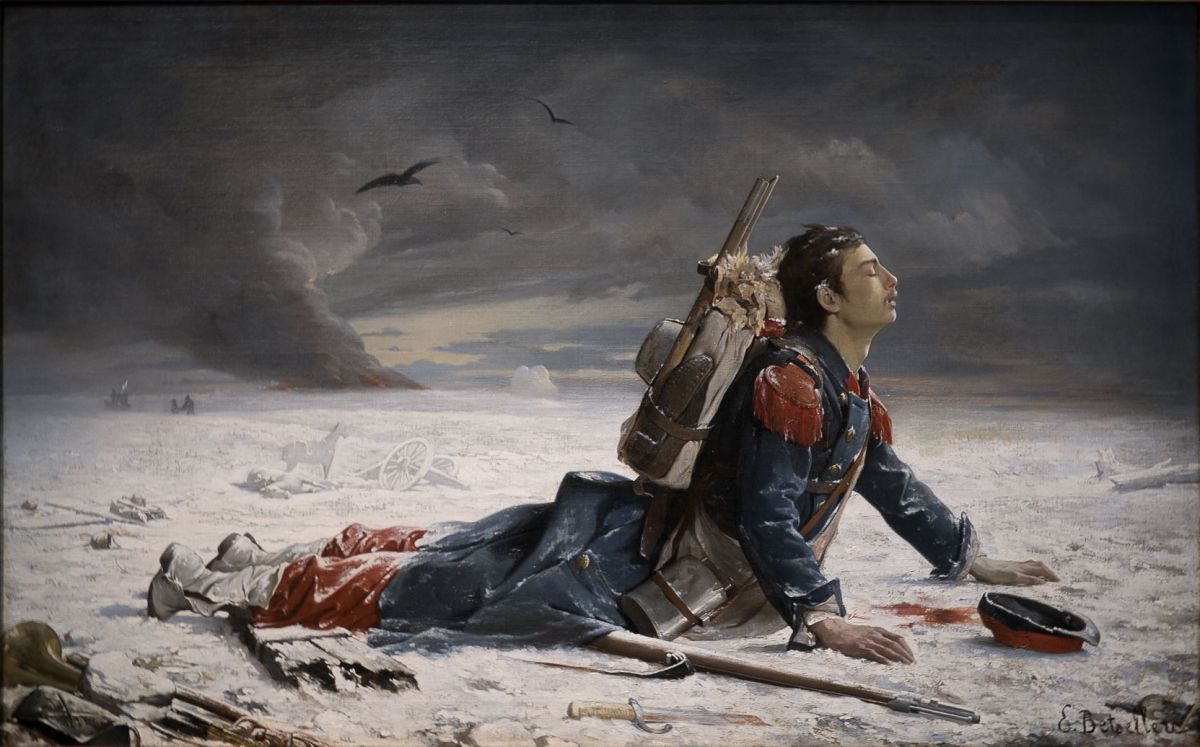
The Franco-Prussian War: Depicting defeat

A fascinating and very detailed account!

hoakley's avatarThe Eclectic Light Company

Painting in Europe during the latter half of the nineteenth century was centred on Paris. A lot happened in other countries too – the Pre-Raphaelites for one – but the major movements of the time all came together in the capital city of France. Yet in the middle of this, from 1870-71, there was a major war in northern France between two of the great empires of the day, France and Prussia. Paris was put under siege, fell to Prussian occupation, and was then torn apart by the Commune.

These events had great impact on art and artists at the time. Some fled for safe places: several went to London, which exposed them to important influences such as the paintings of Turner and Constable, who were formative to the Impressionists. Some died during that war, and promising and very influential careers were terminated abruptly. Many stayed, and witnessed the horrors…

View original post 1,194 more words

Categories
Uncategorized

Jeden Freitag ist das so…

Wolfregen & Constanze's avatarDas poetische Zimmer

Zwölf Uhr mittags

Amtsrat Igler kommt nach Haus,
So wie er’s immer tut:
Mit unbändiger Wut,
Sein Chef, man sollt ihm eine langen,
Ist wieder vor 12 Uhr gegangen!
Sein dicker Kopf, der ist ganz rot,
Die kleinen Augen voller Schrot
Und Frau und Kinder, Katz und Maus,
Die baden nun den Ärger aus,
Er kann kaum reden, kann kaum schnaufen,
Das Wochenende ist gelaufen.

Jeden Freitag ist das so,
Kein Chef mehr im Büro,
Er fühlt sich ausgenutzt –
Ein Glück, dass abends Western kommen,
Im Sessel hat er Platz genommen,
Denn wie James Stewart und John Wayne
Für Sauberkeit und Ordnung stehn,
Gehört der Schlendrian gestutzt,
Dafür er auch die Brille putzt,
Ihn darf, wenn’s losgeht, niemand stören,
Er will die Helden sehen, hören.

Cowboystiefel hat er schon,
Jetzt fehlt nur noch der Hut,
Ein Sheriffstern wär gut,
Dann könnt er die Banditen stellen
In bleigeschwängerten Duellen!
Im…

View original post 170 more words

Categories
Uncategorized

A walk up Moel Siabob

Beautiful photographs and I like the map itinerary!

ms6282's avatarDown by the Dougie

Untitled

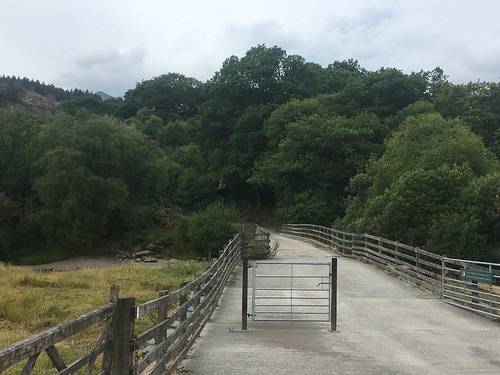
Looking out of my bedroom window at the Bryn Tyrch hotel I had a good view of Moel Siabob, the highest peak in the Moelwynion mountain range. It’s a shapely mountain that stands on it’s own, 2860 feet high, to the south of the A5. It was my destination on the second day of my break in Snowdonia.

I set out from the hotel with a packed lunch in my rucsack fairly early as I wanted to be back in good time to get ready to eat and then watch England play Croatia in the World Cup Semi Final that evening. After a walk down a short stretch of the A5 I crossed the road near the Moel Siabod café and followed the path along the river through the forest.

Untitled

Untitled

At Pont Cyfyng I joined a very steep tarmacked road signposted for Moel Siabob. It was hard work for a…

View original post 406 more words

Categories
Uncategorized

“The Moods” by William Butler Yeats

Categories
Uncategorized

Durch stille Gassen, auf verwunschnen Wegen…

Schöne!

Wolfregen & Constanze's avatarDas poetische Zimmer

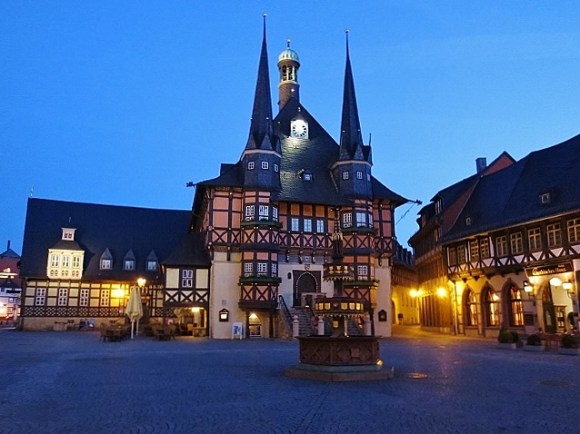
Marktplatz mit Rathaus und Wohltäterbrunnen in Wernigerode, Foto:©Constanze
~ Auf Herzwegen ~

So gern bin ich mit dir in alten Städten,
durch stille Gassen, auf verwunschnen Wegen
gehn wir und gehen wie durch Ewigkeit
und atmen leis verlassne Orte,
du reichst mir deine Hand mit Zärtlichkeit –
Erinnerungen ohne Worte…

Dann möcht ich sacht mein Herz an deines legen,
als ob wir beide nur noch eines hätten,
das weit sich öffnet und uns innig schlägt
und einem Brunnen gleicht am Markt, der trägt
das Wellenspiel mit Liedern an das Leben –
in Liebe allem Schönen hingegeben…

©Constanze

View original post

Categories
Uncategorized

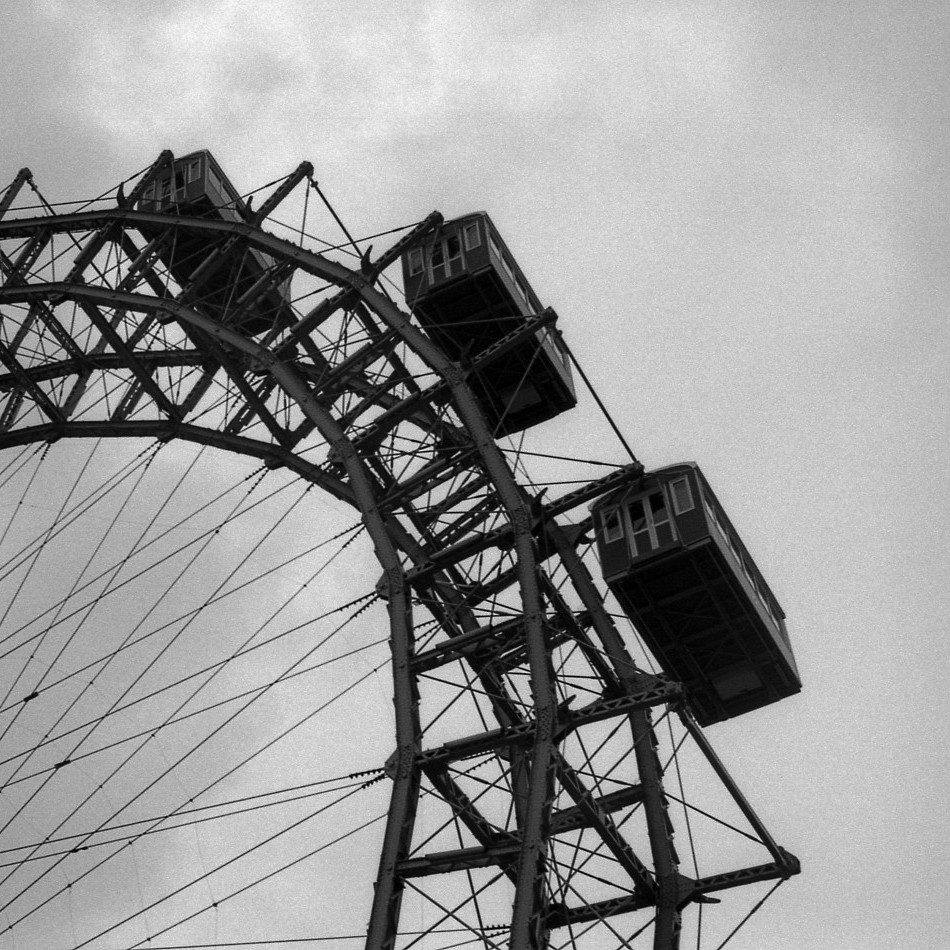
Random photos of Vienna (Adox Silvermax and Exa IIb)

Categories
German Matters Literature Poetry

Vor dem Sommerregen-Rilke

Rainer Maria Rilke

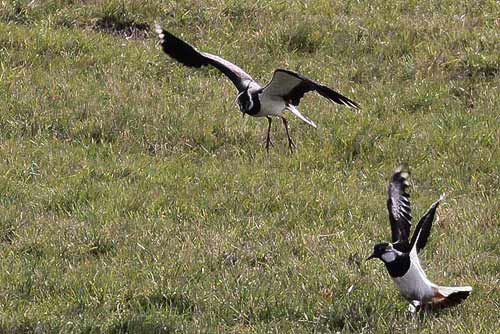
Image result for regenpfeifer in dem Wald vogel

Vor dem Sommerregen

Auf einmal ist aus allem Grün im Park
man weiß nicht was, ein Etwas fortgenommen;
man fühlt ihn näher an die Fenster kommen
und schweigsam sein. Inständig nur und stark

ertönt aus dem Gehölz der Regenpfeifer,
man denkt an einen Hieronymus:
so sehr steigt irgend Einsamkeit und Eifer
aus dieser einen Stimme, die der Guß

erhören wird. Des Saales Wände sind
mit ihren Bildern von uns fortgetreten,
als dürften sie nicht hören was wir sagen.

Es spiegeln die verblichenen Tapeten
das ungewisse Licht von Nachmittagen,
in denen man sich fürchtete als Kind.

Before the Summer Rain

Suddenly, from all the green around you,

something-you don’t know what-has disappeared;

you feel it creeping closer to the window,

in total silence. From the nearby wood

you hear the urgent whistling of a plover,
reminding you of someone’s Saint Jerome:
so much solitude and passion come
from that one voice, whose fierce request the downpour

will grant. The walls, with their ancient portraits, glide
away from us, cautiously, as though
they weren’t supposed to hear what we are saying.

And reflected on the faded tapestries now;
the chill, uncertain sunlight of those long
childhood hours when you were so afraid.

More analysis of this poem in German may be found at http://www.rilke.de/forum/viewtopic.php?t=137

Categories
Uncategorized

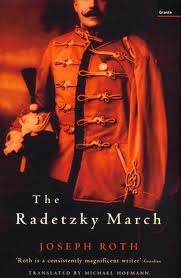
The Radetzky March, by Joseph Roth, translated by Michael Hofman #BookReview

Roth is a great writer and strongly recommend -Summer Before the Dark: Stefan Zweig and Joseph Roth, Ostend 1936 by Volker Weidermann too!

Lisa Hill's avatarANZ LitLovers LitBlog

The Radetzky March is listed in 1001 Books so I pounced when I saw it at the library!

This is why the editors included it:

The Radetzky March ranks as one of the finest European historical novels of the twentieth century and is the outstanding literary work produced by the prolific journalist and novelist Joseph Roth.

Through three generations of the Trotta family, the story traces the decline of the Hapsburg Empire in its dying days, but this is not a family saga.  From the hero of the battle of Solferino who saves the Emperor Franz Joseph’s life and is subsequently ennobled from plain Lieutenant Trotta to Baron von Trotta and Sipolje; to his son Herr Van Trotta who becomes the District Commissioner; to his grandson Carl-Joseph who has an indifferent peacetime career in the army, the book focusses just on these three men who are all, effectively, bachelors, and how they…

View original post 727 more words