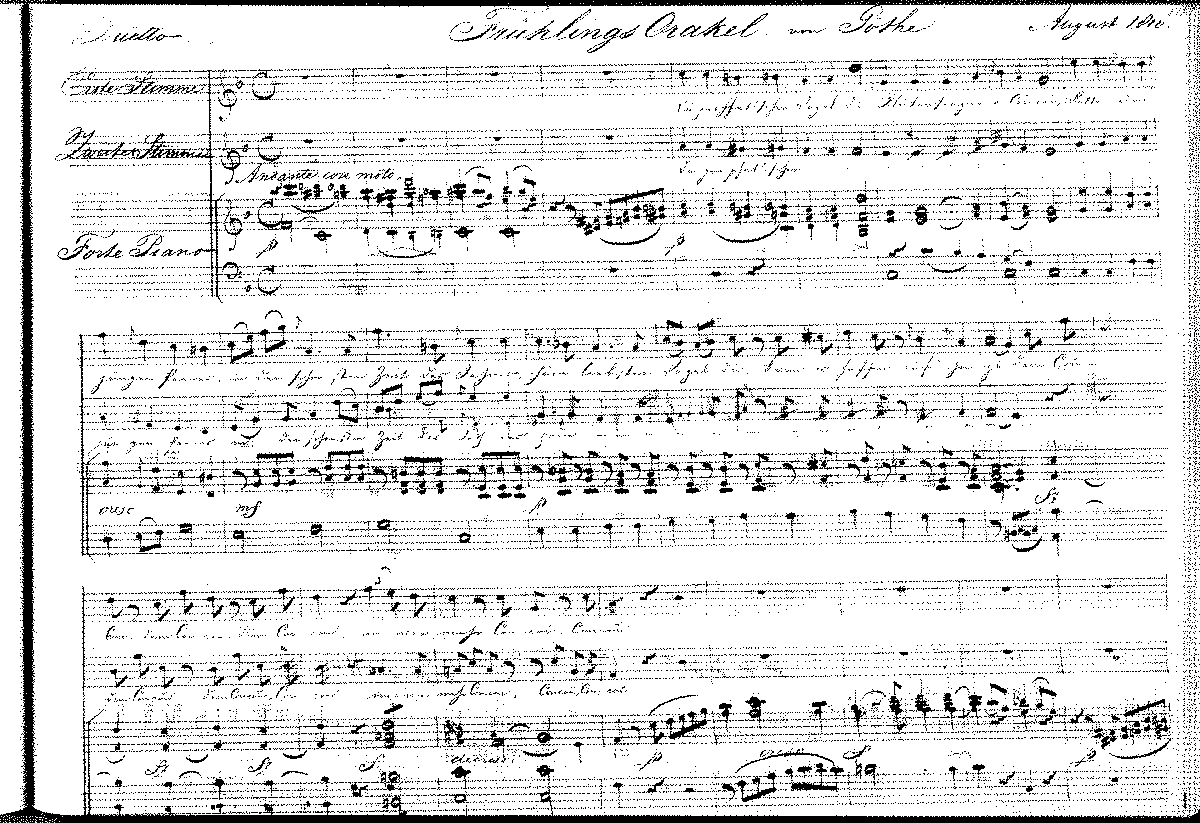
Du prophetscher Vogel du,
Blütensänger, o Coucou!
Bitten eines jungen Paares
In der schönsten Zeit des Jahres
Höre, liebster Vogel du;
Kann es hoffen, ruf ihm zu:
Dein Coucou, dein Coucou,
Immer mehr Coucou, Coucou.
Hörst du! ein verliebtes Paar
Sehnt sich herzlich zum Altar;
Und es ist bei seiner Jugend
Voller Treue, voller Tugend.
Ist die Stunde denn noch nicht voll?
Sag, wie lange es warten soll!
Horch! Coucou! Horch! Coucou!
Immer stille! Nichts hinzu!
Ist es doch nicht unsre Schuld!
Nur zwei Jahre noch Geduld!
Aber, wenn wir uns genommen,
Werden Pa-pa-papas kommen?
Wisse, daß du uns erfreust,
Wenn du viele prophezeist.
Eins! Coucou! Zwei! Coucou!
Immer weiter Coucou, Coucou, Cou.
Haben wir wohl recht gezählt,
Wenig am Halbdutzend fehlt.
Wenn wir gute Worte geben,
Sagst du wohl, wie lang wir leben?
Freilich, wir gestehen dirs,
Gern zum längsten trieben wirs.
Cou Coucou, Cou Coucou,
Cou, Cou, Cou, Cou, Cou, Cou, Cou, Cou, Cou.
Leben ist ein großes Fest,
Wenn sichs nicht berechnen läßt.
Sind wir nun zusammen blieben,
Bleibt denn auch das treue Lieben?
Könnte das zu Ende gehn,
Wär doch alles nicht mehr schön.
Cou Coucou, Cou Coucou :,:
Cou, Cou, Cou, Cou, Cou, Cou, Cou, Cou, Cou(Mit Grazie in infinitum)
Neben dem Bach
Den roten Weiden nach
Haben in diesen Tagen
Gelbe Blumen viel
Ihre Goldaugen aufgeschlagen.
Und mir, der längst aus der Unschuld fiel,
Rührt sich Erinnerung im Grunde
An meines Lebens goldene Morgenstunde
Und sieht mich hell aus Blumenaugen an.
Ich wollte Blumen brechen gehn;
Nun laß ich sie alle stehn
Und gehe heim, ein alter Mann.(1915)
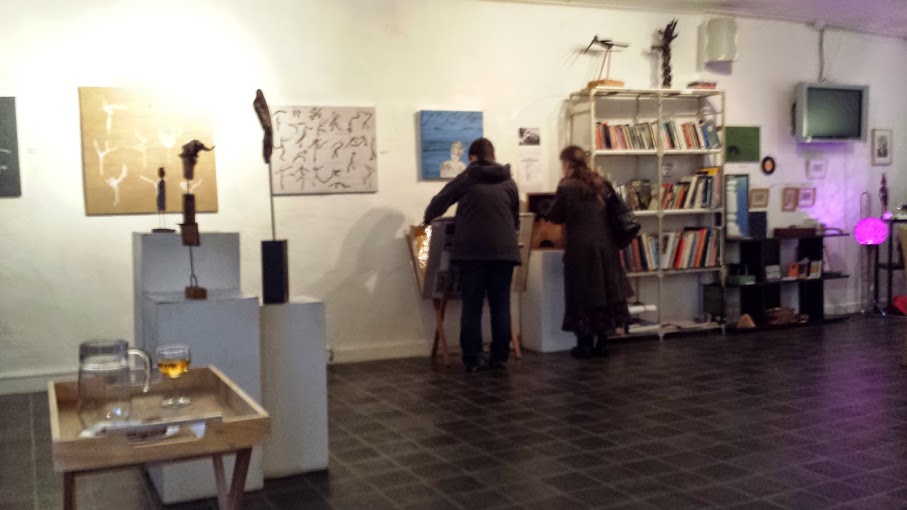
St Ives-based multi media artist Mary Fletcher has co-ordinated an interesting exhibition in The Redwing Gallery, Penzance on behalf of volunteers at the venue. This runs until the end of January and has already received positive reviews such as that by the well-known local poet and commentator, Frank Ruhrmund. Writing in the Cornishman at http://www.westbriton.co.uk/Volunteers-thanked-gallery-assistance/story-25852842-detail/story.html, he states about the exhibition and the co-ordinator herself, “A gallery renowned for its support and promotion of outsider art, it is not all that surprising that Mary Fletcher should feel at home there. It is only two years since, for the first time in her long career, that she has been able to enjoy a working space outside of her house, at White’s Old Workshops in Porthmeor Road, St Ives. Many will recall her solo show held last year in the St Ives Arts Club Arts which celebrated her first year in her new working space.”
Mary Fletcher at The Redwing
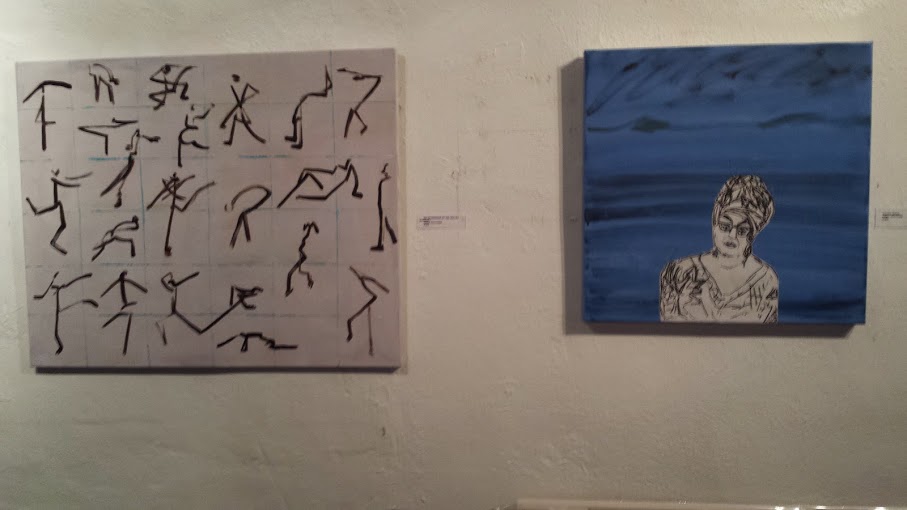
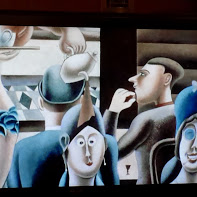
The relaxed atmosphere in The Redwing owes something to its bohemian ambience and partly due to its secluded location. The comfortable seating, bookstands and available refreshments all add to the effect. Here, Peter Fox and Ros Williams, co-directors of the Redwing Gallery, have created a space which is primarily concerned with outsider art. The current exhibition certainly adds to the general comfortable charm of the space. Mary Fletcher’s lyrical canvases remind me of an excellent and memorable exhibition by Litz Pisk who had worked at the Old Vic Theatre School (b.1909 in Vienna) many years ago at Newlyn Art Gallery. Interestingly, a student of Max Reinhardt, Pisk designed for Brecht and Weil’s first
Figures by Litz Pisk (not at The Redwing)
production. http://www.baacorsham.co.uk/mparkin/p65.htm and also her film work for Isodora is at http://www.imdb.com/name/nm0685496/ Mary Fletcher’s paintings too look a little like dancing musical characters against a colourful background grid. There are also a number of interesting sculptures and small figurines in the exhibition which are also worthy of attention.
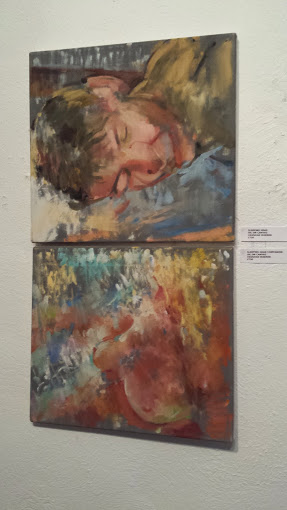
Once again, Vaughan Warren, educated at the Royal Academy Schools (The RA Schools was founded in 1769, and remains independent to this day. This independence enables the Schools to offer the only three-year postgraduate programme in Europe.) has turned in a range of varied and intriguing work. Two of his pictures, I found particularly appealing, although it is worth remarking that all his paintings, like his self-portrait in the manner of Cezanne, benefit from his wide knowledge of art history. The first portrays a sleeping head surmounted delicately above a breast in a transport of lovely colours. This evocative duo puts one in mind of those lovely lines from W.H.Auden:-
“Lay your sleeping head, my love,
Human on my faithless arm;
Time and fevers burn away
Individual beauty from
Thoughtful children, and the grave
Proves the child ephermeral:
But in my arms till break of day
Let the living creature lie,
Mortal, guilty, but to me
The entirely beautiful.”
The second painting,energetic and interesting, executed in black, white and greys shows a view above St Just and looks down literally upon, in the distance, the Great Western Hunt in progress. As Wilde once remarked, ” The Unspeakable in Pursuit of the Uneatable”. The unspeakable in this context means appalling, horrendous, wretched and indeed may remind one of another poem of Auden’s in quite another way:-
From Musée des Beaux Arts (1940)
“Anyhow in a corner, some untidy spot
Where the dogs go on with their doggy
life and the torturer’s horse
Scratches its innocent behind on a tree.”
Mr Vaughan Warrent Admission is free, and this show by the gallery’s volunteers can be seen in the Redwing Gallery, Wood Street, off Market Jew Street, Penzance, 11am to 4pm.
Into my heart an air that kills From yon far country blows: What are those blue remembered hills, What spires, what farms are those?
That is the land of lost content, I see it shining plain, The happy highways where I went And cannot come again.
The condition of being in Exile, is one common element in the human condition. It is certainly an important factor in Irish culture as is well pointed out in this excerpt from The Guardian on Beckett and Joyce – http://www.theguardian.com/world/2010/feb/28/ireland-exile-culture
Here Sean O’Hagan mentions,”This sense of spiritual as well as cultural displacement was evoked, too, by the poet Patrick Kavanagh, who walked the streets around Ealing Broadway in 1953 willing himself to remember his native Monaghan “until a world comes to life – morning, the silent bog”. In the second half of that same decade, an estimated half a million people left Ireland to begin their lives all over again, abroad.” There is spiritual exile, linguistic exile and the sense of personal exile when someone close dies or moves away, in an emotional or geographical sense.
George Klaar (1920-2009)
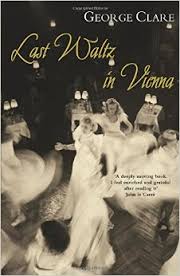
I have just been reading a deeply moving account of lost Austrian-Jewish culture in George Klaar’s Last Waltz in Vienna and was sorry to hear of his passing.http://www.independent.co.uk/news/obituaries/george-clare-memoirist-who-recalled-life-in-nazi-vienna-and-postwar-berlin-1726060.html .This threnody mentions his experiences not only in Vienna but also in Berlin, from where Klaar attempted his escape from the Nazis, initially to Ireland. A different approach and general introduction to exilliteratur (http://en.wikipedia.org/wiki/Exilliteratur) is to be found in Martin Maunthner’s book on German Writers in French Exile 1933-1940. Mauthner was born in Leningrad of Austrian parents. He worked in journalism and with the
Katharina Mann in Munich in 1905-she later converted to Lutheranism
European Commission in Brussels as a senior information officer. He also worked with Randolph Churchill on the biography of the latter’s father. In fact the book centres around a small port near Toulon. It makes much mention too of Aldous Huxley, Somerset Maugham,H.G.Wells, Muggeridge and Mosley. The French writers, Malraux and Gide are included in this account of the émigré community which provides an introduction to the intellectual drama and the tragic zeitgeist of this seven year period. The major figures are naturally Thomas, whose wife Katia came from a wealthy Jewish family of mathematicians, and his francophile brother Heinrich Mann, as well as Thomas’s son Klaus who engaged in a bitter battle of words at one stage with the Berlin based, Gottfried Benn- before the latter was to realise the full implication of Goebbel’s authoritarian drive from 1933 to achieve the synchronisation of the arts (Gleichschaltung) from his Ministry of Propaganda as Weimar collapse. Directed against Bolshevism it engendered militarism and focussed on anti-semitism taking in gypsies and homosexuals on the way and ending in the horrors of the Holocaust. This was all under the title of popular enlightenment. The account by Mauthner lacks the stylistic verve of George Klaar’s biographical account which affords an insight into the historical development of fascism upon Jewish life in Vienna.
Many Jews who were physically harassed and otherwise threatened by the Nazis and travelled to many locations and were exiled to Amsterdam, Stockholm, Zürich, London, Prague, Moscow as well as across the Atlantic to both North and South America. Martin Mauthner’s book seems to have three great strengths. It shows the wide variety of responses of individual refugees and their attempts to organise opposition to Hitler and the hampering difficulties other countries governments and other organisations presented. There is considerable detail about individuals like Feuchtwanger and Schwarzschild, famous at the time and now unfortunately neglected as well as journalists, publishers, cartoonists and illustrators. This book confines itself to writers, poets and playwrights but is particularly intriguing on the splits with the communists and within the United Front. The cruel trials under the auspices of Stalin proving a profound sticking point; also the different approaches in the Spanish Civil War.
Leopold Schwarzschild Editor of Das Neue Tagebuch
Just this morning I recieved an interesting posting concerning classical antiquity from http://poemsintranslation.blogspot.co.uk/ with a version of Ovid’s Tristia and the mortifying effects of having to leave his wife behind in charge of his posessions.
Illa dolōre āmēns tenebrīs nārrātur obortīs sēmjanimis mediā prōcubuisse domō,
utque resurrēxit foedātis pulvere turpī crīnibus et gelidā membra levāvit humō,
sē modo, dēsertōs modo complōrāsse Penātēs, nōmen et ēreptī saepe vocāsse virī,
nec gemuisse minus, quam sī nātaeve meumve vīdisset strūctōs corpus habēre, rogōs,
et voluisse morī, moriendō pōnere sēnsus, respectūque tamen nōn periisse meī.
Vīvat, et absentem, quoniam sīc fāta tulērunt, vīvat et auxiliō sublevet usque suō.
Translated by A.Z.Foreman as:-
I’m told she fainted from grief, mind plunged in dark, And fell half-dead right there in our house. When she came round, with disheveled dust-fouled hair, Staggering up from the cold hard ground, She wept for herself, for a house abandoned, screaming Her stolen man’s name time after time, Wailing as though she’d witnessed our daughter’s body Or mine, upon the high-stacked pyre; And longed for death, to kill the horror and hardship, Yet out of regard for me she lived. Long may she live! And in life give aid to her absent Love, whose exile the Fates have willed.
Du lernst ihn in einer Gesellschaft kennen.
Er plaudert. Er ist zu dir nett.
Er kann dir alle Tenniscracks nennen.
Er sieht gut aus. Ohne Fett.
Er tanzt ausgezeichnet. Du siehst ihn dir an…
Dann tritt zu euch beiden dein Mann.
Und du vergleichst sie in deinem Gemüte.
Dein Mann kommt nicht gut dabei weg.
Wie er schon dasteht – du liebe Güte!
Und hinten am Hals der Speck!
Und du denks bei dir so: “eigentlich …
Der da wäre ein Mann für mich ! ”
My provisional and tentative translation for which is:-
You get to know him around and about.
He chats and seems friendly.
He knows who are the latest tennis stars.
He looks great-no fat anywhere.
He dances beautifully.
Then both of you remember your husband!
…and when you compare them in your thoughts
Your husband doesn’t come out of it very well!
Goodness, how he has become already!
The back of his neck like a lump of bacon.
You think to yourself, ”Well actually,
There goes the chap for me…”
These, however, are only the first two verses and then the implication neatly reverses again, delightfully….
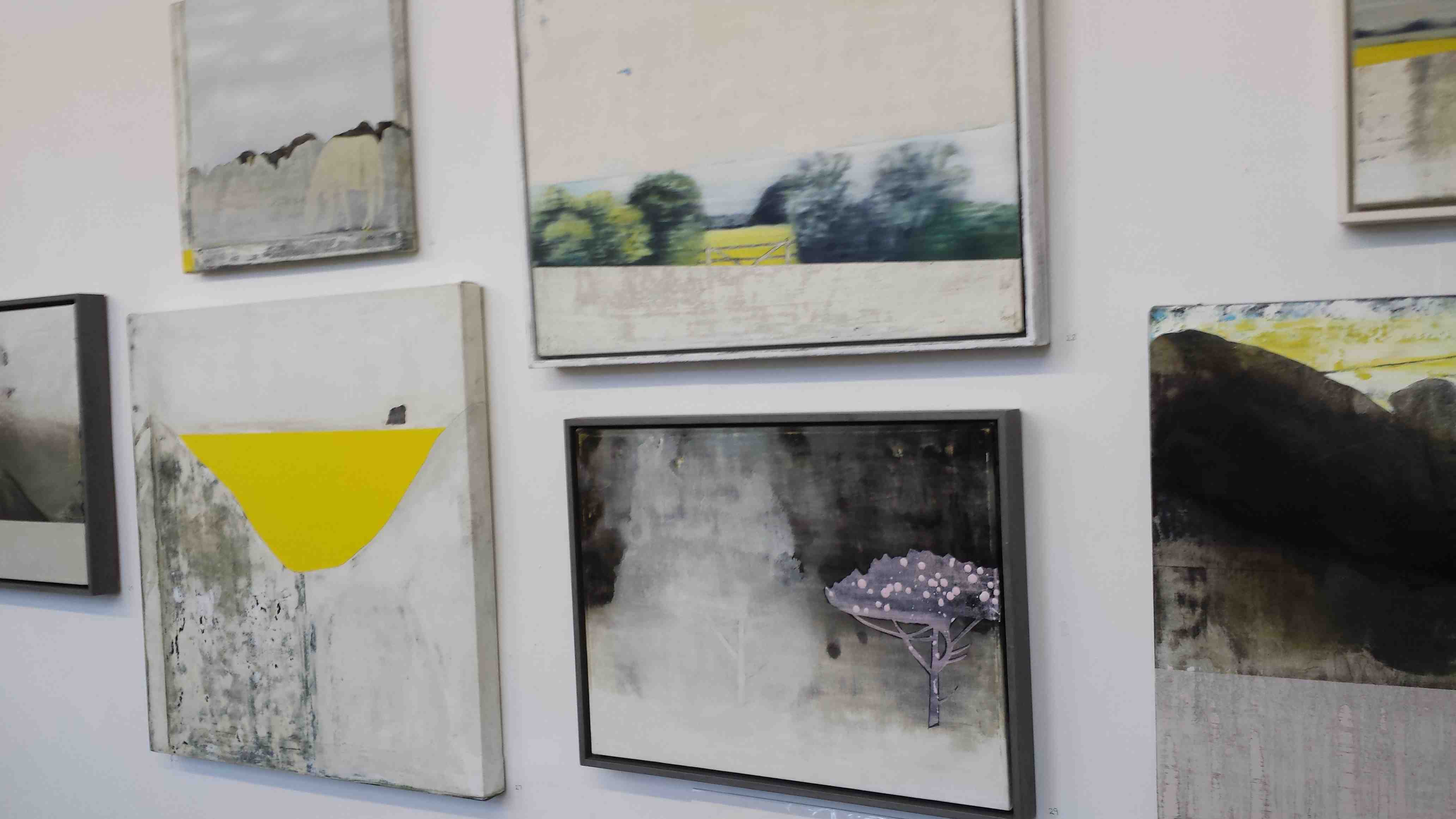
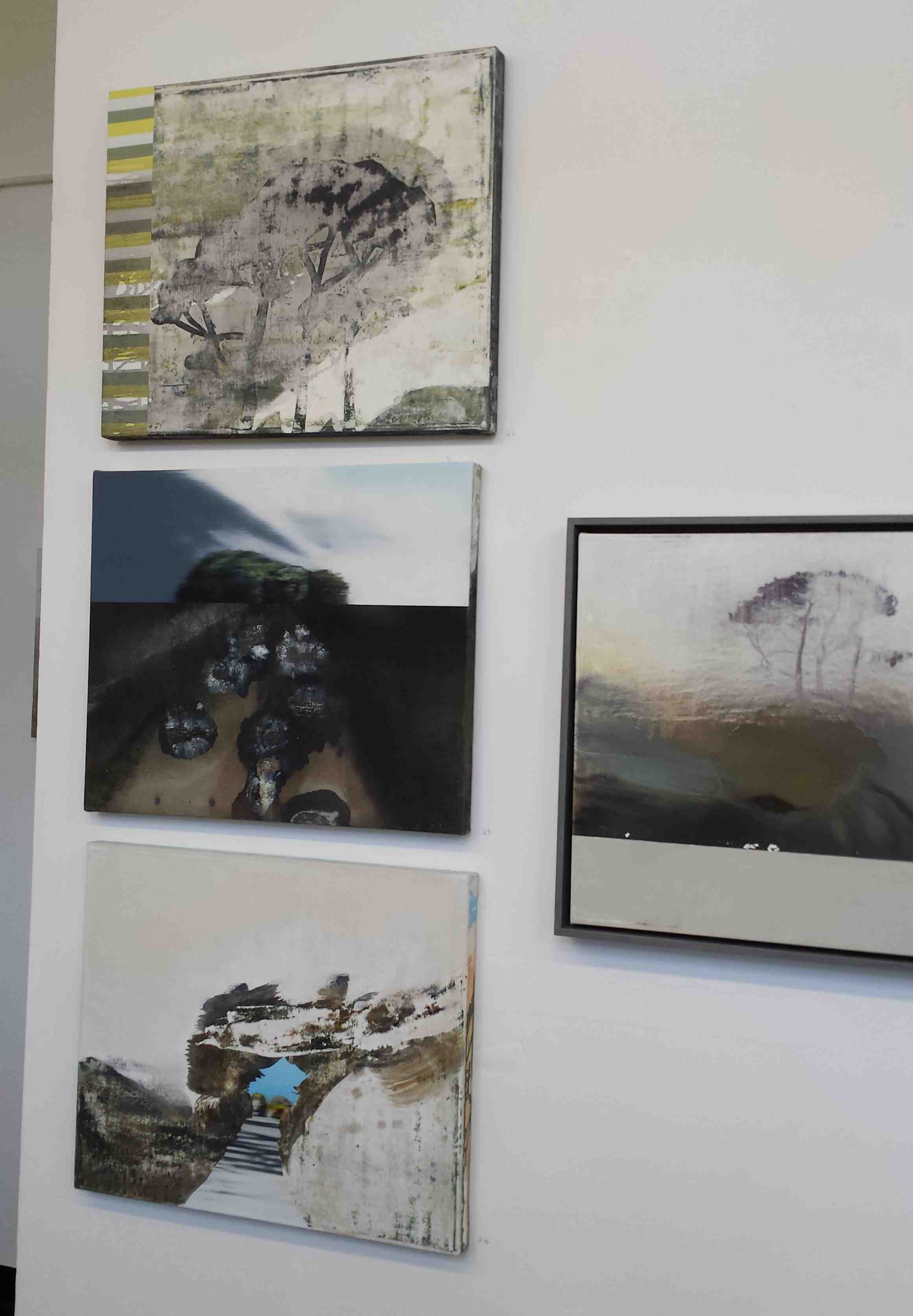
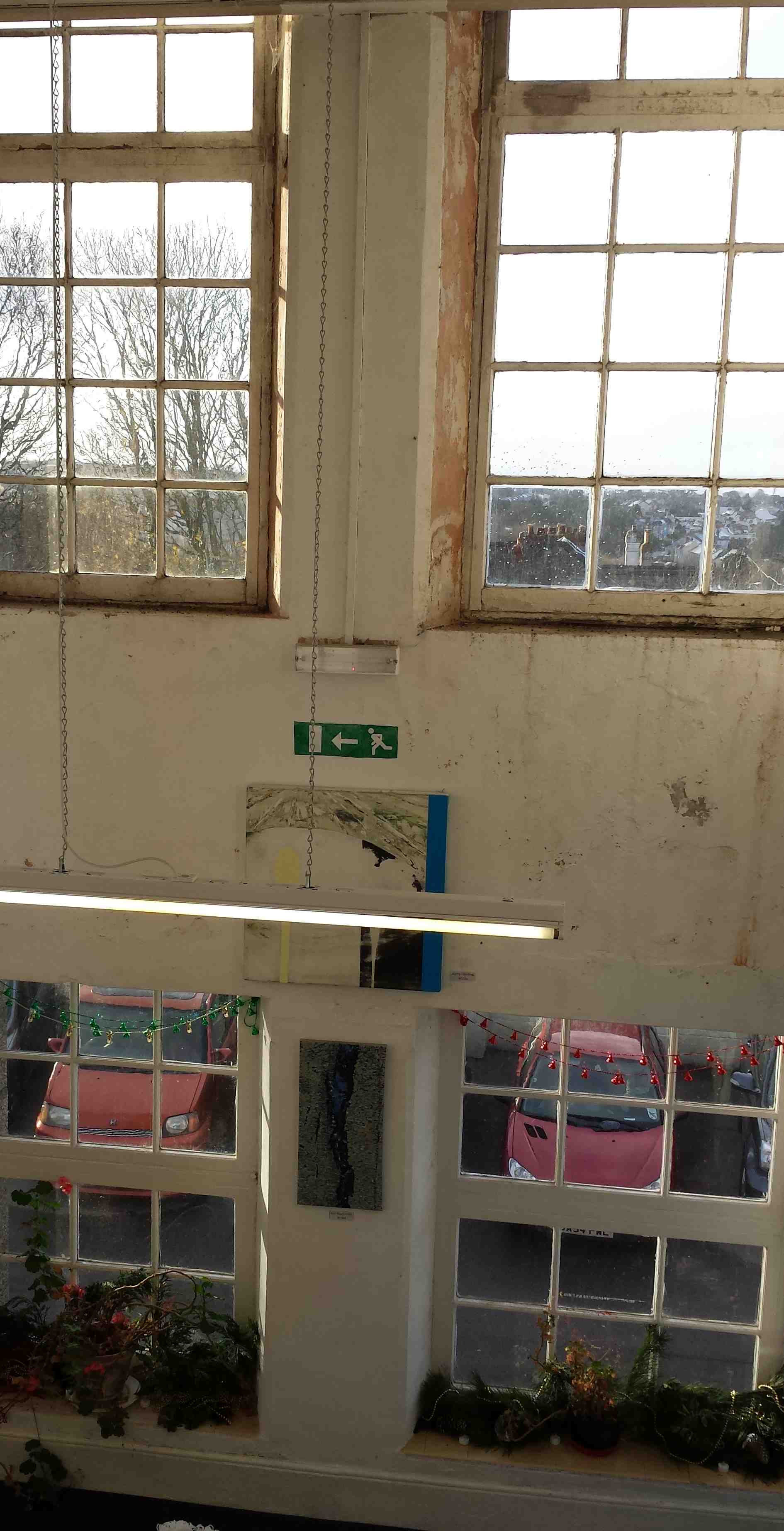
Kerry Harding’s soft and evocative canvases take the natural world around the North
Kerry Harding at work in her studio at Krowji
Coast with it’s trees, hedges and seasonal variations as a starting point. Her website may be found at http://www.kerryharding.co.uk/. Kerry was very interesting on the topic of the famous Dresden artist, Gerhard Richter https://www.gerhard-richter.com/en/ mentioning his process, his photographic work and his continuous experimentation using a wide variety of methods and sometimes controversial subject matter. She also mentioned his ability to work on different projects simultaneously. She worked very hard to create a welcoming atmosphere in her space- as she says on Twitter, “studio almost ready, tinsel and fairy lights then its done.” A lovely range of paintings that I found so interesting that I came back to browse them for a second time. It was also informative to hear how some canvases were composed of many underpaintings-up to ten or more layers.
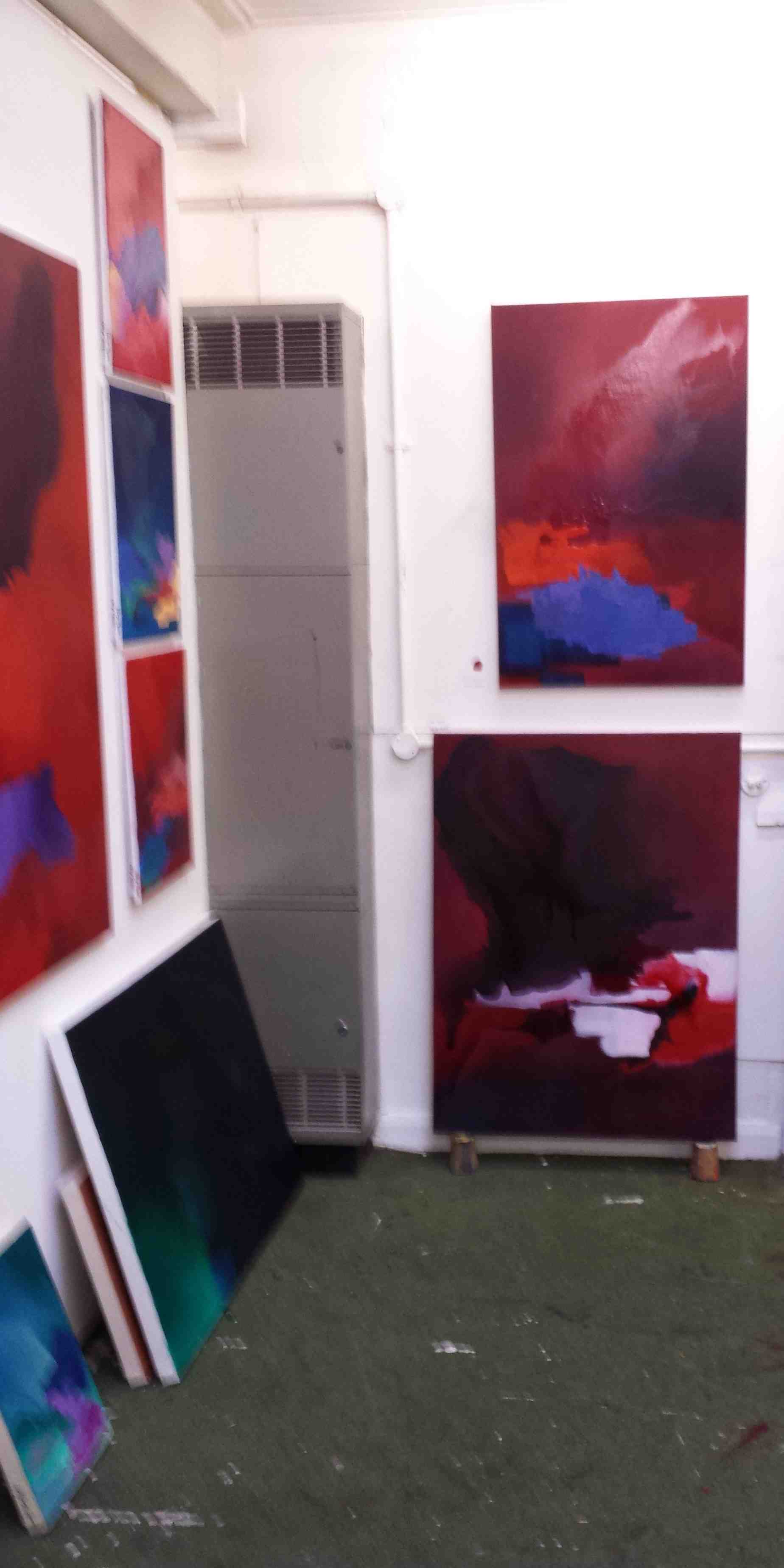
Kathryn Stevens, http://kathrynstevens.co.uk/, clearly rejoices in the freedom of working on a large scale. The billowing colours of her canvases express the joy of painting in bright colours. Some of them have a feathery and eloquent quality that puts one in mind of Georgia O’Keeffe (or perhaps Otto Gottlieb) but here we have an abstract expressionism with an upbeat and optimistic feel. She told me how she works freely, sometimes with music and chatted with the same exuberance that her work conveys. I was particularly taken by a study in
Kathryn Stevens’s studio
crimson, scarlet and white. She hails from St Ives and her paintings exhibit the wondrous light for which the town has become famous.
In short there was much to add cheer on a cold Sunday. It was good to see the Siobhan Purdy’s work again- which adorns the wall opposite as I write, the Mexican and Maya themed prints in the Apex space and to talk again with Naomi Singer whose glass works continue to thrive. Interesting too were the textile pieces by Zoe Wright.
Esther Connon -Work in progress
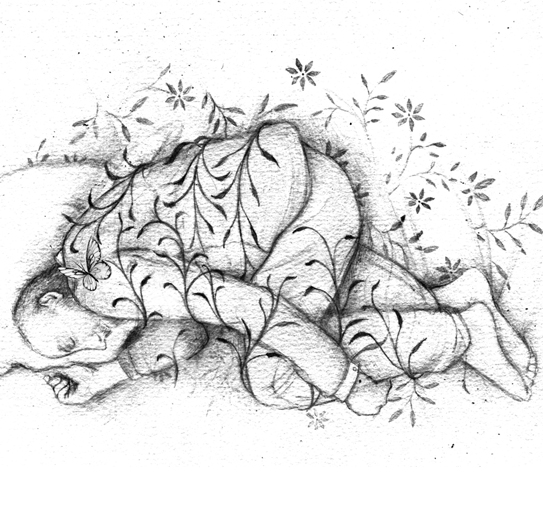
Before returning to the Melting Pot once again, I went into see the illustration work of Esther Connon and was much taken by her story of TheWhite Butterfly which can be seen on http://www.estherconnon.co.uk/stories.html?s=5. I wondered if it would be possible to animate some of this according to the methods of http://thepapercinema.com/ and this fascinating method may be seen both on videos on the papercinema site and on the community project in St Ives filmed earlier this year by my friend Alban. Altogether with the new building project at Krowji already under-way, great developments can be expected from this artistic phoenix rising from the ashes of the Grammar School at Redruth.
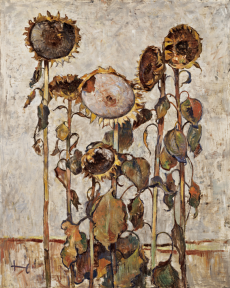
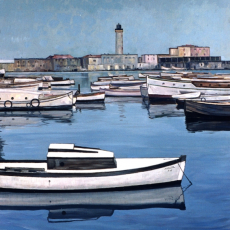
Between 1918 and 1924 Hauer studied at the Academy of Fine Arts in Vienna with Josef Jungwirth and Karl Sterrer . In 1927 he had his first solo exhibition at the Neue Galerie Vienna (with Otto Nirenstein-Kallir).
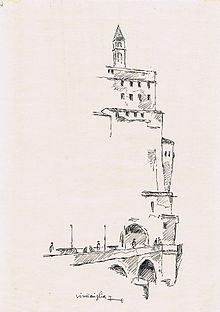
Ventimiglia 1955
Arthur Roessler the Austrian art historian (http://de.wikipedia.org/wiki/Arthur_Roessler) wrote in 1927 in an essay in “Austrian Art” about Leopold Hauer: “Finally, once again, we have a man that is not only painter, but a painter that is a true artist , A creative artist endowed with instinct and intelligence, one that does not just produce “Decorate your home with Pictures”. Rather a man who shows himself to us as a gifted or talented artist and an individualist, without as immediate predecessor to showed the way. He is not a naturalist nor is he doctrainaire, he promotes originality and translates his impressions. He has achieved this already with so much skill that anyone who views his pictures is capable of experiencing both their sensual captivating charm and the pure spiritual enjoyment which they induce.”
Schatz came from a family of civil servants and attended the Vienna School of Applied Arts.With 22 years of commitment to the political left, the artist had already appeared as a book illustrator for Arthur Roessler and also for Josef Luitpold Stern. Schatz illustrated books in the interwar period, especially literature from theStrom-Verlag(including Stefan Zweig , Jack London , Upton Sinclair’s “Co-op” and Peter Roseggers “Jakob the Last”).
“The Hope,” by Otto Rudolf Schatz.
1925 was the Great Treasure State Award, 1928-38 he was a member of the Hagenbund . He lived during the Second World War treasure in Brno, Prague and later in a sub-camp of Gross-Rosen concentration camp in Graditz admitted that he “jüdisch-versippt” -which apparently meant that by his marriage he was considered part of the Jewish “clan”. Schatz became, on his return, by the City Councillor for Culture. His first prize for the design of the Wiener Westbahnhofs remained unrealized.
“Die Hoffnung” has the erotic interest that figures in much of Schatz’s work and is vaguely reminiscent of the sardonic style of Edward Burra, who has recently been the subject of a programme by Andrew Graham-Dixon called “I never tell anyone, anything”. This intriguing programme is available on You-Tube at https://www.youtube.com/watch?v=4BoLh8xgOdI
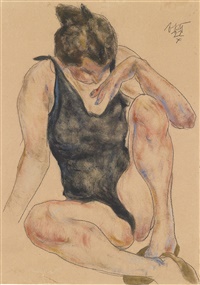
Extract from a painting by Edward BurraSitzende im schwarzgrüne Trikot
I came across this lovely painting by Sergius Pauser in the Leopold Museum in Vienna. Mädchen vor dem Spiegel was painted in 1931 and Öl auf Leinwand, 92×73 cm, so oil on linen. The limited range of colour, the tone and the style, that is to say, The New Objectivity (in German: Neue Sachlichkeit), along with the model’s expression give this painting an attractive and contemplative feeling. The subject is, of course, a common one for artists including Lovis Corinth (1918) and famously Picasso (1932). It is also similarly the subject of the self-portrait by Zenadia Serebryakova as mentioned in my earlier posting http://penwithlit.wordpress.com/2011/12/19/self-portraits-1900-1912-3-zinaida-serebryakova/. Other paintings by Pauser will be found at http://www.sergius-pauser.at/
Quoting from the above link, this passage is of considerable interest,”The writer Thomas Bernhard (1931-1989) wrote of Pauser: “Sergius Pauser uttered thoughts about people – Adalbert Stifter, for example – that I have never heard before or since; he succeeded in revealing the most concealed corners of poetic sensitivity; he was a tender and vigilant diviner on the landscape of world literature, a philosopher and an artist through and through.” And yet a painter like Sergius Pauser is barely known today; only a few of his works hang in Austrian galleries and many of his paintings cannot be traced due to the emigration of their owners.”
Pauser was considered unreliable by the Nazis and had a tough time as recorded by Wikipedia.de:-“In seiner Monographie berichtet Rupert Feuchtmüller (S. 22), dass Sergius Pauser im Herbst 1944 mit fünftausend sogenannten „Politisch Unzuverlässigen“ in ein Schanz-Lager bei Radkersburg gebracht wurde. Der Schauspieler Curd Jürgens, der auch bei diesem Transport war, schreibt über diese Zeit: „… Ich weiß, dass Sergius sowohl als auch Boeckl … recht viel Unangenehmes durchmachen mussten, da die SA-Bewacher mehr und mehr die Nerven verloren und dies an den Gefangenen ausließen.“ (Curd Jürgens in seinen „Erinnerungen“, Autobiographischer Roman, Droemer Knaur Verlag 1976)”
Here are three more paintings by Pauser that appeal to me. Amerikanerin1948,
Luis Trenker mit Kamera, 1938Amerikanerin
has an appealing delicacy and an optimistic and conversational appeal. The hardboard realism of Luis Trenker mit Kamera, 1938,Mischtechnik auf Hartplatte from an earlier period reminds me of a favourite painter, Christian Schad. I cannot find a colour image for Mädchen mit rotem Hut, 1942 Agathe Prinzessin von Ratibor but am intrigued to find that she was a Princess of a Polish town called Racibórz in Polish but very close to the Czech border and called Ratiboř.
In the Leopold Museum in the Museum Quarter of Vienna, I discovered a number of artists about whom I had not previously heard. One of the most interesting was Egger-Lienz.
The oeuvre of Egger-Lienz includes many oil paintings. Several of his designs and drawings are available in various versions and images. Some subjects, such as the Mountain Mowers, are lithographs.
1904 Egger-Lienz turned to the theme of the sower, which kept him busy until the 1920s. The prototype for this was Jean-François Millet (The Sower , 1851), the other inspiration was actually a work of Giovanni Seganti. 36 major works were exhibited in 1901 at the Secession. Characteristic of Egger-Lienz is also the long time between recognising a source to its development or use.
1904/05 in South Tyrol The Pilgrims originated, whose formal conception parallels to Ferdinand Hodler’s picture The Truth (1903), which was exhibited along with 30 other works belonging to Hodler in the spring of 1904 in the Secession. Although the first drafts of The Pilgrims showed in the middle a seated Madonna with Child, Egger-Lienz replaced them, under Hodler;’s influence by the Crucified Christ. By means of this painting Egger-Lienz made a breakthrough to his “monumental-decorative period”