Als ich als junger Mann den Mädchen den Hof machte
Spielte ich ein Wartespiel
Wenn ein Mädchen mit wallenden Locken mich zurückwieß
Ließ ich die alte Erde ein paar Umdrehungen machen
Während ich sie mit Tränen anstatt Perlen bearbeitete
Und mit der Zeit kam sie zu mir
Mit der Zeit kam sie
Wenn du dich mit den jungen Mädchen im Frühling triffst
Machst du ihnen mit Liedern und Reimen den Hof
Sie antworten dir mit Worten und einem Kleeblatt-Ring
Aber wenn du die Dinge, die sie bringen, unter die Lupe nimmst
Haben sie wenig zu bieten, außer der Lieder, die sie singen
Und reichlich verschwendeter Zeit
Reichlich verschwendeter Zeit
Oh, es ist eine lange, lange Zeit
von Mai bis Dezember
Aber die Tagen werden kürzer
Wenn der September eintrifft
Wenn das Herbstwetter
Die Blätter rötlich färbt
Bleibt keine Zeit
für das Wartespiel
Oh, die Tage schwinden
Zu wenigen zusammen
September, November
Und diese wenigen kostbaren Tage
Werde ich mit dir verbringen
Diese kostbaren Tage
Werde ich mit dir verbringen
Übersetzung: Marc Rothballer für Sinatra
Das vielleicht schönste Lied aus Andersons und Weills „Knickerbocker Holiday“ ist der „September Song“, der bei der Erstaufführung von Walter Houston interpretiert wurde, und der auf Wunsch von Alexej unser neues Wochenthema sein soll.
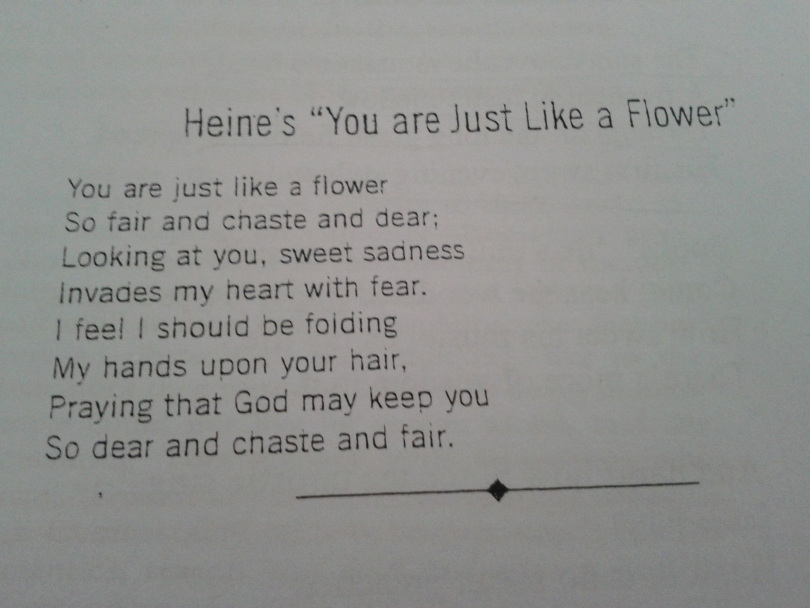
Du bist wie eine Blume
So hold und schön und rein;
Ich schau’ dich an,
Und Wehmut schleicht mir ins Herz hinein.
Mir ist, als ob ich die Hände
Aufs Haupt dir legen sollt’,
Betend, daß Gott dich erhalte
So rein und schön und hold,
Betend, daß Gott dich erhalte
So rein und schön und hold.
I
Ich trete in die dunkelblaue Stunde –
da ist der Flur, die Kette schließt sich zu
und nun im Raum ein Rot auf einem Munde
und eine Schale später Rosen – Du!
Wir wissen beide, jene Worte,
die jeder oft zu anderen sprach und trug,
sind zwischen uns wie nichts und fehl am Orte:
dies ist das Ganze und der letzte Zug.
Das Schweigende ist so weit fortgeschritten
und füllt den Raum und denkt sich selber zu
die Stunde – nichts gehofft und nichts gelitten –
mit ihrer Schale später Rosen – Du.
II
Dein Haupt verfließt, ist weiß und will sich hüten,
indessen sammelt sich auf deinem Mund;
die ganze Lust, der Purpur und die Blüten
aus deinem angestammten Ahnengrund.
Du bist so weiß, man denkt, du wirst zerfallen
vor lauter Schnee, vor lauter Blütenlos,
totweiße Rosen, Glied für Glied – Korallen
nur auf den Lippen, schwer und wundengroß.
Du bist so weich, du gibst von etwas Kunde,
von einem Glück aus Sinken und Gefahr
in einer blauen, dunkelblauen Stunde
und wenn sie ging, weiß keiner, ob sie war.
III
Ich frage dich, du bist doch eines andern,
was trägst du mir die späten Rosen zu?
Du sagst, die Träume gehn, die Stunden wandern,
was ist das alles: er und ich und du?
«Was sich erhebt, das will auch wieder enden,
was sich erlebt – wer weiß denn das genau,
die Kette schließt, man schweigt in diesen Wänden
und dort die Weite, hoch und dunkelblau.»
This very lovely poem appears in the useful collection “The Faber Book of 20th Century German Poems” where it has been translated by Michael Hofmann:-
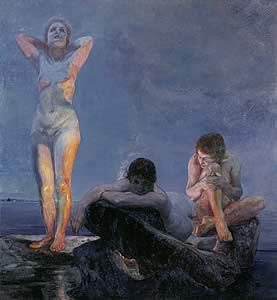
Blue Hour
I
I enter the deep blue hour-
here is the landing, the chain shuts behind
and now in the room only carmine on a mouth
and a bowl of late roses-you!
We both know, those words
we both spoke and often offered others
are of no account and out of place between us:
this is everything and endgame.
Silence has advanced so far
it fills the room and seals it shut
the hour-nothing hoped and nothing suffered-
with its bowl of late roses-you.
II
Your face blurs, is white and fragile,
meanwhile there collects on your mouth
all of desire, the purple and the blossoms
from some ancestral flotsam stock.
You are so pale, I think you might disintegrate
in a snowdrift, in unblooming
deathly white roses, one by one-coral
only your lips, heavy and like a wound.
You are so soft, you portend something
of happiness, of submersion and danger
in a blue, a deep blue hour
and when it is gone, no one knows if it was.
III
I remind you, you are another’s,
what are you doing bearing me these late roses?
You say dreams bleach, hours wander.
what is all this: he and I and you?
‘What arises and arouses, it all comes to an end,
what happens- who exactly knows,
the chain falls shut, we are silent in these walls,
and outside is all of space, lofty and dark blue.’
Die blaue Stunde (L’heure bleue), 1890; Öl auf Leinwand. Leihgeber: Museum der bildenden Künste Leipzig.
There is an interesting analysis of this poem by the Italian translator and scholar, Stefanie Golisch at http://www.fixpoetry.com/feuilleton/lesarten/gottfried-benn/blaue-stunde/ingeborg-bachmann/die-blaue-stunde
A new translation of Benn’s poems by Michael Hofmann called “Impromtus” is reviewed at http://www.theguardian.com/books/2014/jan/31/impromptu-selected-poems-gottfried-benn-review
There is also a You Tube reading at https://www.youtube.com/watch?v=RAs1t3evQW4
Here is a review of Richley’s collection by my friend and poet Roland Gurney:-
Naming The Tree-Simon Richey-Overstep Books-48pp paperback £8
This first collection from a London-based writer(published in reputable magazines such as Magma,Acumen & Poetry Review) has mostly rural or
existential themes and curiously little sense of city life. Prose poem sequences
such as the title piece, a thirteen section on Fire and a ten section meditation on the nocturnal activities of the author’s cats loom large. This is ‘free verse’, devoid of much imagery, music, structure or rhythm- example ‘And because there was no word anymore, no sound in which/its meaning could be carried/the meaning had nowhere to go,’ rather thoughts on themes such as The Word(opening) and the Book(closing). This is poetic minimalism, much in vogue and going back to stateside influences such as WC Williams(the 6 liner The Red Wheelbarrow), Wallace Stevens and the Beats via TS Eliot’s The Wasteland and a host of contemporary imitators.
As such it will hopefully give pleasure to some but cannot be rated good value for money as some pages only have 6-9 lines on them. For not much more one can buy a 500 page Bloodaxe anthology of exceptional quality and offering a whole range of poetic experiences!
Roland Gurney.
The reviewer is an award-winning and much-published poet based at
Mulfra, Newmill just outside Penzance.
Oversteps Books are to be found at http://www.overstepsbooks.com/events/2653/
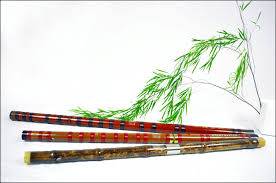
Abend atmete aus Blumenblüten,
Als im fernen Winde wer die Flöte blies.
Laßt mich eine Gerte von den Zweigen brechen,
Flöte schnitzen und wie jene Flöte tun.
Wenn die Nächte nun
Ihren Schlaf behüten,
Hören Vögel, wie zwei Flöten süß
Ihre Sprache sprechen.
(Li-tai-pe)
(Alfred Henschke) Klabund
Aus der Sammlung Chinesische Gedichte
The Distant Flutes by Li Tai Pe -a free translation
The evening is seeped in the heavy scent of rose blossom
As the distant winds catch the notes of flutes.
Let me carve a such a flute myself
from this overhanging branch
May the night guard you
as you sleep,
Lulled listening to the birds, as two sweet melancholy
flutes whisper to you in your own secret language.
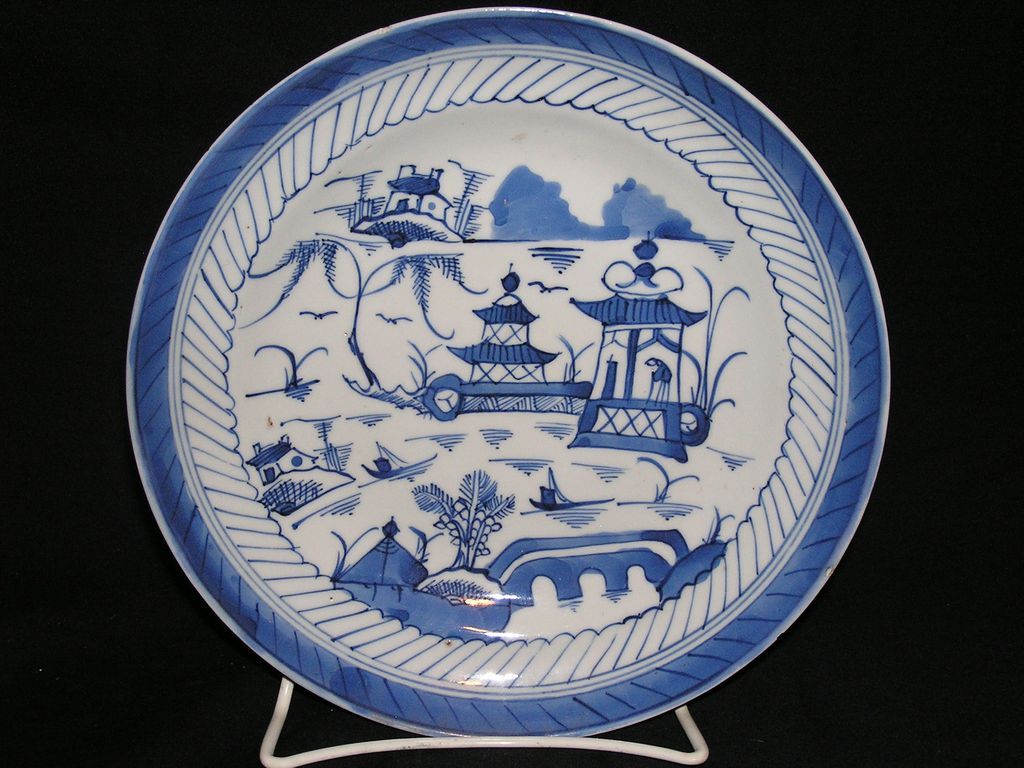
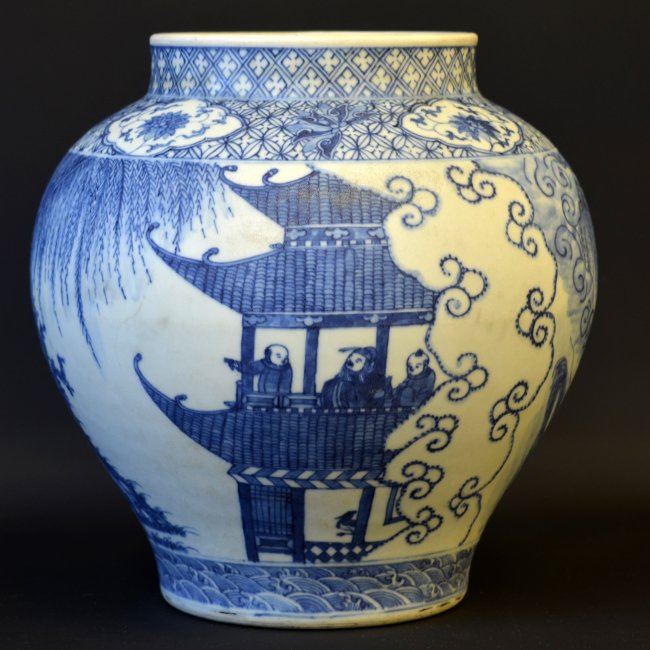
In dem künstlich angelegten Teiche
Auf der Insel steht der Pavillon von grün und weißem Porzellan.
Man gelangt in seine gläsernen Bereiche
Über eines weißen Tigers Rücken, der sich hier als Brücke aufgetan.
Dort sitzen Freunde froh beim Weine. Licht
Ist der Gewänder Farbe, die sich nicht im Staub der Wochentage placken.
Die Freunde plaudern oder schweigen heiter. Einer schreibt ein Gedicht,
Streift die Ärmel zurück und wirft das Haupt in den Nacken.
Sieh: in dem Teich, in dem die Jadebrücke, in den Wellen leise wehend,
Sich wie ein Halbmond wölbt, der Freunde trunknen Wahn!
Die Kleider zitternd! Auf dem Kopfe stehend
In einem Pavillon von Porzellan!
Li-tai-pe
A free translation of this, is as follows:-
The Porcelain Pavilion
A white and green pavilion made out of porcelain
depicts beautifully elaborate pools.
See how these glassy dominions spring from
the white back of a tiger
that here, serves as a bridge.
On one side the company enjoy their wine. The colour
of their garments radiates as white.
These are not grimy from their daily labours.
The friends chat or just sink into a cheerful silence.
One writes a poem
as another stretches up his arm and scratches
the back of his neck.
See just how above the pools and the jade bridge
and the gently plashing waves,
how the curving crescent of the moon arches
over the drunken folly of these friends.
Their very clothes seem to shiver as one man stands on his head
and unhappy Albert, the hard-working Saxon Elector.
-The relaxed, navy-cut beard of the one,
hysterical, bristling moustaches of the other…….
The Expressionists were Rupert Brooke’s generation.
Their hold on life was weaker than a baby’s.
Their deaths, at whatever age, were infant mortality-
a bad joke in this century. Suddenly become sleepy,
they dropped like flies, whimsical, sizzling,
ecstatic, from a hot light-bulb. Even before the War,
George Heym and a friend died from a skating accident.
From 1914, they died in battle and of disease-
or suicide like Trakl. Drugs Alcohol Little Sister.
One was a student at Oxford and died, weeks later,
on the other side……..Later they ran from the Nazis.
Benjamin was turned back at the Spanish border-
his history of the streets of Paris unfinished-
deflected into an autistic suicide. In 1938,
Ödön von Horváth, author of naturalistic comidies,
was struck by a falling tree. In Paris.
At the time
my anthology was compiled, there were still a few left:
unexplained survivors,
psychoanalysts in the New World.
From the collection of Michael Hoffmann’s selected poems at http://www.amazon.co.uk/Selected-Poems-Michael-Hofmann/dp/0374532230/ref=sr_1_fkmr2_2?ie=UTF8&qid=1403993437&sr=8-2-fkmr2&keywords=michael+hoffman+Selected++poems- This web-address also contains two useful reviews.
Mascha Kaléko (1907 – 1975) wurde als Tochter jüdischer Eltern in Galizien geboren und wuchs in Berlin auf. Sie wurde als Dichterin bekannt und verkehrte im berühmten »Romanischen Café«. Doch 1935 erhielt Mascha Kaléko Publikationsverbot und musste mit Mann und Sohn nach New York emigrieren. Nach dem Krieg fand sie mit ihren so spielerisch eleganten wie spöttisch scharfsinnigen Texten wieder ein großes Publikum.
Mein schönstes Gedicht
Mascha Kaléko
Mein schönstes Gedicht ?
Ich schrieb es nicht.
Aus tiefsten Tiefen stieg es.
Ich schwieg es.
Das Ende vom Lied
Ich säh dich gern noch einmal, wie vor Jahren
Zum erstenmal. – Jetzt kann ich es nicht mehr.
Ich säh dich gern noch einmal wie vorher,
Als wir uns herrlich fremd und sonst nichts waren.
Ich hört dich gern noch einmal wieder fragen,
Wie jung ich sei … was ich des Abends tu –
Und später dann im kaumgebornen «Du»
Mir jene tausend Worte Liebe sagen.
Ich würde mich so gerne wieder sehnen,
Dich lange ansehn stumm und so verliebt –
Und wieder weinen, wenn du mich betrübt,
Die vielzuoft geweinten dummen Tränen.
– Das alles ist vorbei … Es ist zum Lachen!
Bist du ein andrer oder liegts an mir?
Vielleicht kann keiner von uns zwein dafür.
Man glaubt oft nicht, was ein paar Jahre machen.
Ich möchte wieder deine Briefe lesen,
Die Worte, die man liebend nur versteht.
Jedoch mir scheint, heut ist es schon zu spät.
Wie unbarmherzig ist das Wort: «Gewesen!»
“Diese eigentümliche Mischung aus Melancholie und Witz, steter Aktualität und politischer Schärfe ist es, die Mascha Kalékos Lyrik so unwiderstehlich und zeitlos macht.”
Wiedersehen mit Berlin
Seit man von tausend Jahren mich verbannt.Ich seh die Stadt auf eine neue Weise,So mit dem Fremdenführer in der Hand.Der Himmel blaut. Die Föhren lauschen leise.In Steglitz sprach mich gestern eine MeiseIm Schloßpark an. Die hatte mich erkannt.
As an introduction to this topic take a quick look at this clip from the excellent film producer, Ken Loach-https://www.youtube.com/watch?v=odZrzqgOruE made for the Tate.
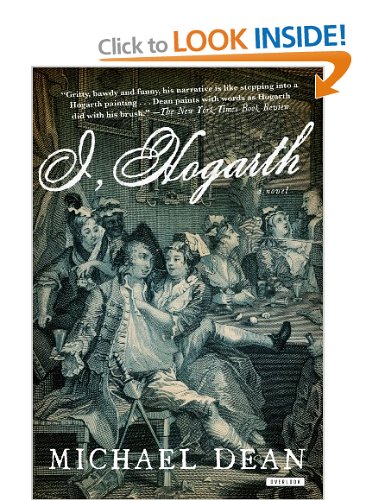
The novel in paperback-I,Hogarth
How similar in many ways was Hogarth’s London in the middle of the Eighteenth Century to the London of today. A city where it was easy enough to end up in debtor’s prison, as indeed did Hogarth’s beloved and unworldly father, having been condemned to the Fleet; a sad fate for a brilliant Latin scholar and writer of erudite texts. He opened a Latin speaking coffee house in St John’s Gate. Here the governor and authorities were open to high levels of corruption, as later in Dickens time and very reminiscent of the scandals of G4S today, from which Bill Gates has just withdrawn his investments. In other respects, the London which Michael Dean so vividly depicts with its gin shops and stews and general squalor appears more genial and creative than the contemporary city. A backdrop is painted where a young chancer such as William Hogarth Esq. can develop his prodigious artistic talents. Beyond the joy of the paintbrush, to say nothing of the etching tool, he ravishes with gusto the charms of both serving wenches and the daughters of his aristocratic patrons. Dean, who is incidentally versed in Chomsky’s linguistics, has furnished his readers with a beguiling study of this genius of visual satire.
There are also rich comparisons to be made between current financial calamities and the South Sea Bubble, the first major crash of the early stock market in 1720 and from which the first Prime Minister, Sir Robert Walpole was deft at concealing his personal involvement. This was the very first subject for Hogarth’s satirical print where he depicts speculators of every religious persuasion gambling on the huge machine which stands for the merry-go-round of unlicensed gambling.
Dean illustrates vividly the crowded and fetid cobbled streets of the old city and his protagonist’s sharp eye for both hypocrisy and the opportunities for Hogarth’s enterprising talent. The account dwells considerably upon the dreadful prisons, already mentioned but also gives us an insight for instance, into the techniques which Bill Hogarth used to portray the dreadful plight of the murderess, Sarah Malcolm two days before her one- way cart ride to Tyburn. Dean shows us Hogarth’s determination to reveal the human qualities of his subject and the skill and concentration when posing her for this portrait. The chameleon nature and psychological adaptability of the great artist is outlined in the constant reappraisals that Hogarth made of his work and even how he recorded his own name.
Samuel Johnson showed his own admirable restraint by his famous remark the actor-manager David Garrick,” I’ll come no more behind your scenes, David for the silk stockings and white bosoms of your actresses excite my amorous propensities.” Hogarth, however, shows little self control in his own sometimes comical and bawdy investigations, some of which were indeed conducted at the dark and chilly recesses in the Royal Theatre. In relation to other members of the female sex, whose general treatment at the time was abysmal, there is a touching bittersweet quality. Infection was to lead to this particular rake’s downfall.
Michael Dean focuses, in a mildly erotic account, upon the exchange of a hooped dress between his own intended, Jane Fenton, and the actress, Lavinia Fenton. The latter lady becoming the subject of further paintings he made of her and of her on-stage appearances. In an innovative and almost Brechtian manner Hogarth considered the inclusion of the audience; an opportunity too to provoke and admonish!
Essentially I,Hogarth is a non-fictional novel, sometimes referred to as a bio-fic; a form which has certain ambiguities and is exemplified by another well-known Eighteenth Century novel about Samuel Johnson, According to Queeney by Beryl Bainbridge where the story of the great man is told through an ancillary close observer. Dean’s book is written in the first person and this adds extra challenges. The style in which it is written, at first noticeable becomes gradually more engaging. There is little in the way of a conventional plot, however the narrative pace is sustained by the energy with which Hogarth pursues his goals, like his wooing of Jane Thornhill in opposition to her father, his patron. Those who wish to progress to a factual biography couldn’t do better than to read William Hogarth: A Life and a World by Jenny Uglow to whom the author refers in a note.
The pleasure in reading this account lies in its vivid, picturesque and satirical world view as seen through Hogarth’s sharp and observant eyes. The reader is introduced to an amusing variety of characters and educated about Eighteenth Century life. Many scenes from the book are posed as in an engraving. It will send people back to really look again at Hogarth’s achievement and support Michael Dean’s
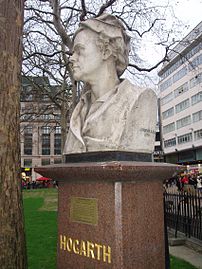
Hogarth’s bust in Leicester Square
heartfelt request for a better memorial to this inspired rebel.









 penwithlit